
A small studio on the North Sea, looking east.
Denki Digital began with a simple wish: to make instruments that feel as though they have a past.
In Japanese, 電気 (denki) means electricity. It is the hum in an old power supply, the glow of a display in a dark room, the moment a circuit becomes a voice. It is also the first word of a company that wanted to name what it cares about.
Aberdeen
Aberdeen is a granite city on the North Sea. For half the year the light is low and silver, the evenings are long, and the sea is never far away. It is a good place for patient work: for listening to a filter close a hundred times until it closes the right way.
Everything here is designed, built, measured and listened to in Aberdeen. One of Kosen's multis is called Aberdeen Neon. It seemed only fair.
Tokyo
Tokyo is the other half. A city where the old and the new stand side by side without argument; where a well-made tool is kept and cared for over decades; where design is often quietest when it matters most.
That is where the names come from, and the manner. A cloud. An echo that answers from the trees. The colour of a tone. Twilight. A firefly. Each instrument begins with a word, and the word decides a great deal.
An instrument should have a voice before it has a feature list.
Digital heritage
The early digital synthesizers are often called cold. We hear something else: the grain of an eight-bit wave, the glass of a twelve-bit one, the way a wavetable steps rather than glides. These were instruments made at the edge of what their chips could do, and the edges are where the character lives.
We don't copy them. We study them, from schematics, manuals and long listening, and then make something new that remembers them. The waves and tables are our own, and so are the panels.
Craft
Every instrument is built from its first principles and tested until it behaves: measured for level, for latency, for the few percent of a processor it is allowed to use. Then it is played, for a long time, before it is allowed to leave.
Each instrument does a job, and does it well. None of them is trying to be everything. They're made to sit beside the big do-it-all synthesizers you already have: the specialist tool you reach for when you want a sound the all-rounders don't make. And like any good tool, each one is looked after for as long as people use it.
They arrive a few at a time. There will be no countdowns, no flash sales, no noise. When an instrument is ready, it will appear here, quietly.
Twelve sounds
Denki Digital instruments are made for experimental, ambient and electronic musicians: people who go looking for sounds rather than settling for them.
So each synthesizer arrives with twelve presets, and only twelve, every one chosen by ear. They are not a catalogue. They go where each instrument is most itself: low and slow, worn and restless, sounds that move on their own and leave long tails behind them. That is where the interesting sounds live.
It's a choice, not a limit. Underneath every preset is a complete synthesizer, and the familiar sounds are all there if you want them: a round bass, a clean lead or a warm pad is a few minutes from Init. We would rather show you what you won't hear anywhere else, and leave the rest in your hands.
Stephen, lover of obscure synths, old electronics and home computers
I've been chasing sounds since I was a teenager. Back then, I lived for the weekend: Aberdeen's legendary Pelican Club, and parties in parts of the city the tourist board doesn't mention, soaking up Underworld, Orbital, 808 State, David Holmes, The Orb, and many others.
My first synth was a Roland JD-800, bought the week it came out, on my dad's credit card (it took years to pay it back). Then came a computer running Cubase, a sampler, and a cheap, noisy mixer. Over the years the collection grew: a D-50, a JX-8P, a Korg M1, a Yamaha SY85, an Alesis QuadraSynth, amongst others. Each one could do something the others couldn't, and finding out what it was never got old.
Then life happened, as it does. I drifted away from music, and the gear went, one sale at a time.
When I came back, everything lived in the computer. Pasting other people's loops in a DAW wasn't doing it for me. I needed something else, something from my own imagination. I kept reading about the instruments that had always fascinated me, most of them now rare or priced like antiques. One evening it occurred to me that I didn't have to just look at them. I could make my own.
What I bring is over thirty years of playing, a head full of ideas, and the patience to test something until it's right. I design every instrument, and the code is written with AI tools, working from those designs. Below is exactly how it works.
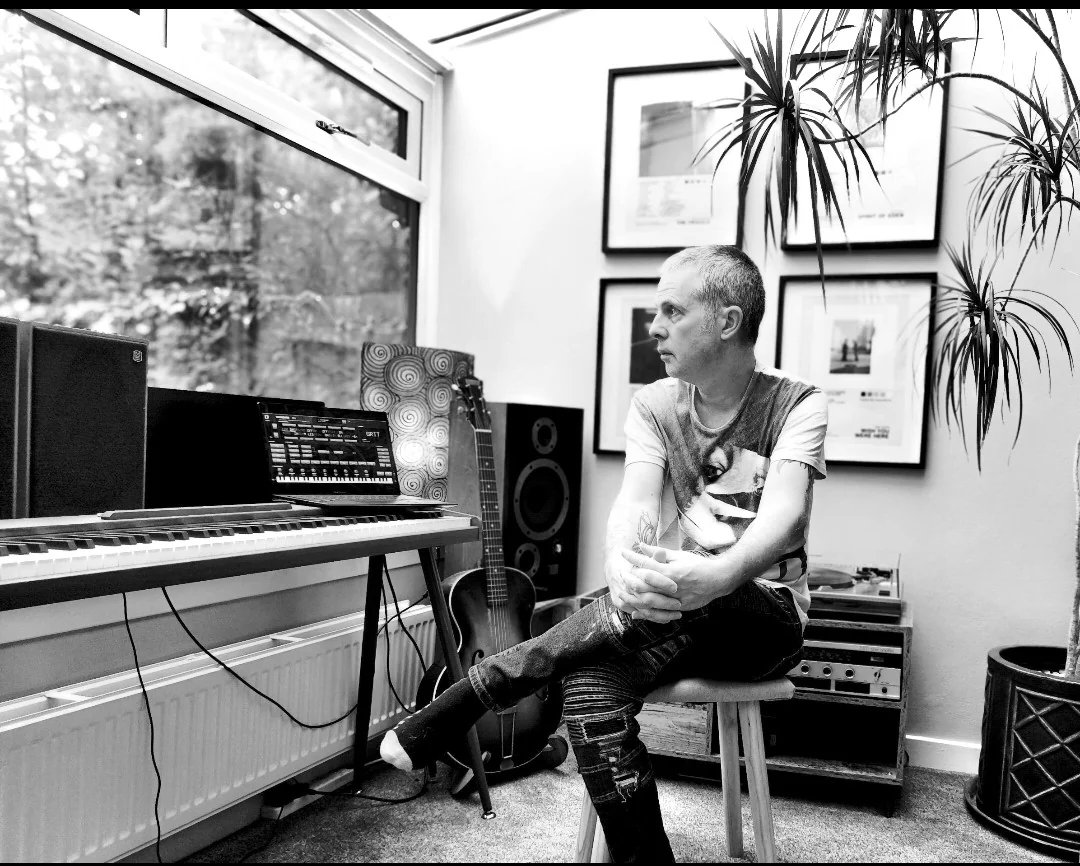
The studio is very modest: a cheap electric piano as a MIDI keyboard, a trusty laptop, and my beloved 1930s JG Abbot archtop: old and battered but still working.
For now there's still a day job. This isn't a get-rich-quick plan, but it's one of those things I'd regret for the rest of my life if I didn't try. The hope is to trade the desk, one day, for a small, fiercely independent studio making instruments that are a bit different, answerable to nobody but the people who play them. If you're one of them, thank you. You're the reason it can happen.
How these instruments are made
I decide what every Denki Digital instrument is: how it sounds, how it plays, how it looks, and, just as importantly, what it leaves out. I test every build, and every preset is chosen by ear: most I programme myself; some begin as sketches that I audition, reshape, or throw away.
The code is written with AI tools, working from my designs and specifications, and now and then they sketch a preset for me to judge. When something isn't right, it goes back as many times as it takes: a filter that closes unnaturally, a knob taper that feels wrong under the hand, or a panel that feels cramped on a laptop screen.
Every note is generated in real time by the instrument's own DSP engine: oscillators, filters, envelopes, delays, and reverbs working as you play. There is no machine learning inside the plugins, and nothing trained on anyone else's music.
I judge every instrument by how it sounds and how it performs. Before any instrument is released:
- Hundreds of automated checks run on every single build.
- Every instrument is tested repeatedly in pluginval, an independent plugin validator, at its maximum strictness.
- Pluginval is only one check. Every instrument has been through several rounds of review and testing, with AI tools and by me: its code searched for faults, and every fix checked again before it goes out.
- Engine response is verified across all host sample rates up to 192 kHz.
- Performance is measured on an Intel Core Ultra 9 laptop: most instruments use 1 to 5% of a single CPU core at 48 kHz, and the largest synthesizers up to about 10% with every voice and effect engaged. Each instrument's page gives its own figures.
- Every instrument is tested in major digital audio workstations.
- And I play every one myself, in my own projects, for a long time, until it feels right under the hand.
Every check, in detail: how every instrument is tested
Once an instrument is released, its control structure is locked. A project saved today will open exactly as you left it after every future update.
You don't have to take my word for it. Hotaru 240 and Tsukumo 99 are free. Download them, play them, and judge by ear.
The Denki Digital commitment: looked after in person
A project you open five years from now should open just as you left it.
I'm building Denki Digital for the long haul. Every instrument, free or paid, is looked after by me in person. As operating systems update, new processors arrive and DAWs change, I'll make sure each one is updated, put through every test again, pluginval at its strictest included, and kept working. Every update is free, for as long as the instrument exists. There's no paid version 2 to buy.
And your instruments never depend on me to keep working. Your licence is a file you keep: nothing phones home, nothing expires, and nothing switches off.
You aren't just buying a plugin. You're trusting an instrument to your studio, and I take that responsibility seriously.
— Stephen Widden, Aberdeen