Kodama
木霊the echo that answers from the trees
Kodama is a magnetic drum echo: four playback heads around a turning drum, or a loop of tape past them, a mixer-channel drive in front, a spring reverb beside it, and the small imperfections that make a repeat feel alive.
Character
In Japanese folklore, a kodama is the spirit of the trees. Call into the forest and it answers.
This one answers from a spinning drum. Each repeat comes back a little softer, a little older, bending with the motor.
Push it, and the loop begins to sing on its own.
What it does
Four heads
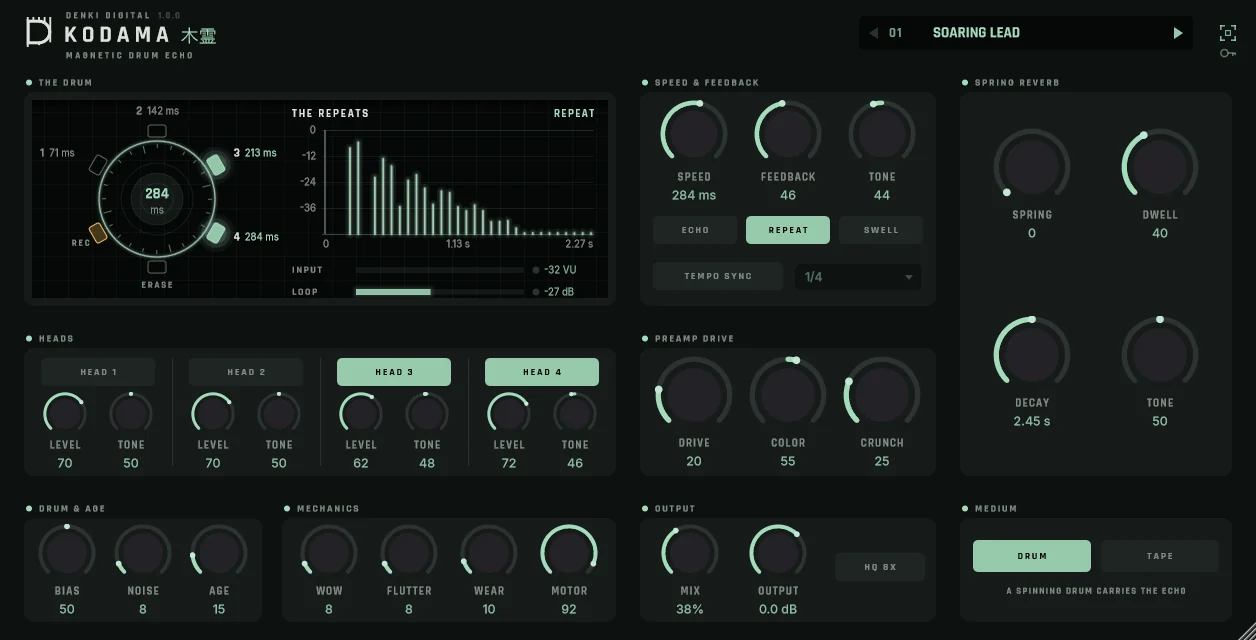
Spaced 1:2:3:4 around the drum, each with its own switch, level and tone. Gallops, slapback, long dub trails.
Echo, Repeat, Swell
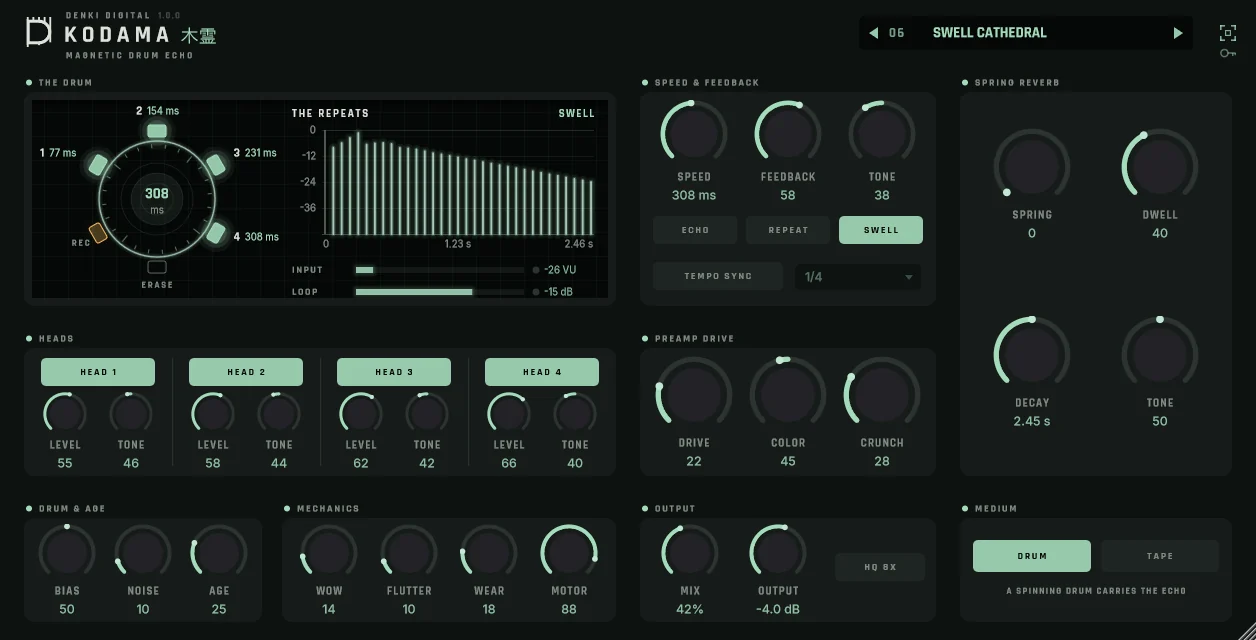
Single repeats. A feedback loop. Or a wash in which every head blooms into the next, close to a reverb.
The drum's mechanics
Wow with the drum's once-a-turn wobble, flutter, and a motor whose steadiness you choose. Change the speed and the repeats glide in pitch.
Age, wear and bias
Hiss and hum, crosstalk between heads, the ghost of the last turn. Worn heads that dull and drop out. The grit or softness of a bias set by hand.
Preamp drive
A soft, uneven input stage, and a harder one inside the loop. Crunch sets the point where the loop begins to break.
Drum or tape
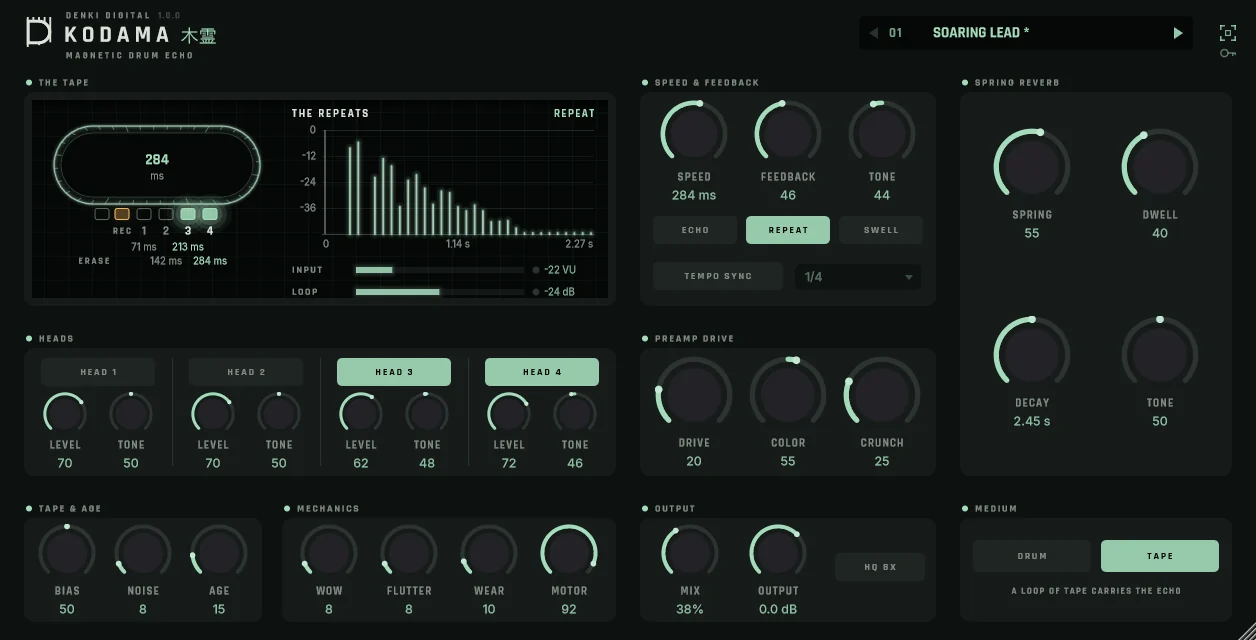
Carry the echo on the steady drum, or on a loop of tape that wobbles more, darkens and thickens with every pass, and has a splice that ticks by once a loop.
A spring reverb
Two springs a channel, beside the echo: Dwell for the twang and the crash, Decay up to 5 seconds, and a Tone that drives them dark or bright. Every hit comes back as a chirp.
Tempo, when you want it
Sync to the host from a sixteenth to a whole bar. When the tempo moves, the drum glides to meet it.
See the repeats
The drum turns in its display with your chosen heads lit, and beside it the pattern of repeats your settings make: where each one lands, and how loud. Push the loop past unity and it turns red.
Views
Technical
| Type | Magnetic drum or tape echo, with preamp drive and spring reverb |
|---|---|
| Heads | Four, spaced 1:2:3:4, each with level and tone |
| Time | 37.5 to 600 ms across the heads; 60 ms to 1.2 s when synced |
| Modes | Echo, Repeat, Swell |
| Medium | Drum or tape |
| Spring reverb | Two springs a channel: Spring, Dwell, Decay (1.2 to 5 s), Tone |
| Character | Wow, Flutter, Motor Stability, Head Wear, Age, Noise, Bias |
| Drive | Drive, Color and Crunch, on the input and in the loop |
| Oversampling | 4x, or 8x in HQ |
| Factory programs | 11, plus a library for your own |
| Latency | 42 samples |
| CPU | About 2% of one core, 3% in HQ; with the spring, about 4% and 5% (stereo, 48 kHz) |
| Channels | Mono, mono to stereo, stereo |
| Format | VST3, and Audio Unit on the Mac · Windows 10 or 11, 64-bit, or macOS 12 or later (Apple silicon or Intel) |
| Manual | The owner's manual, as a PDF |
From the factory programs
Also in the studio
Kumo
雲 · cloudA stereo reverb for long ambient tails and slow blooms, with five algorithms that range from dark and heavy to bright and shimmering.
Enter Vintage Channel StripKohaku
琥珀 · amberA stereo channel strip based on the channel of an old rack mixer: a preamp that warms up as you push it, a two-band tone stage and a pair of VU meters.
Enter Cross-Wave Hybrid SynthesizerTasogare
黄昏 · twilightA hybrid synthesizer where digital waves feed an analogue-style voice, in four layers that can each sound eight-bit, twelve-bit or clean.
Enter