
Niji
虹rainbow
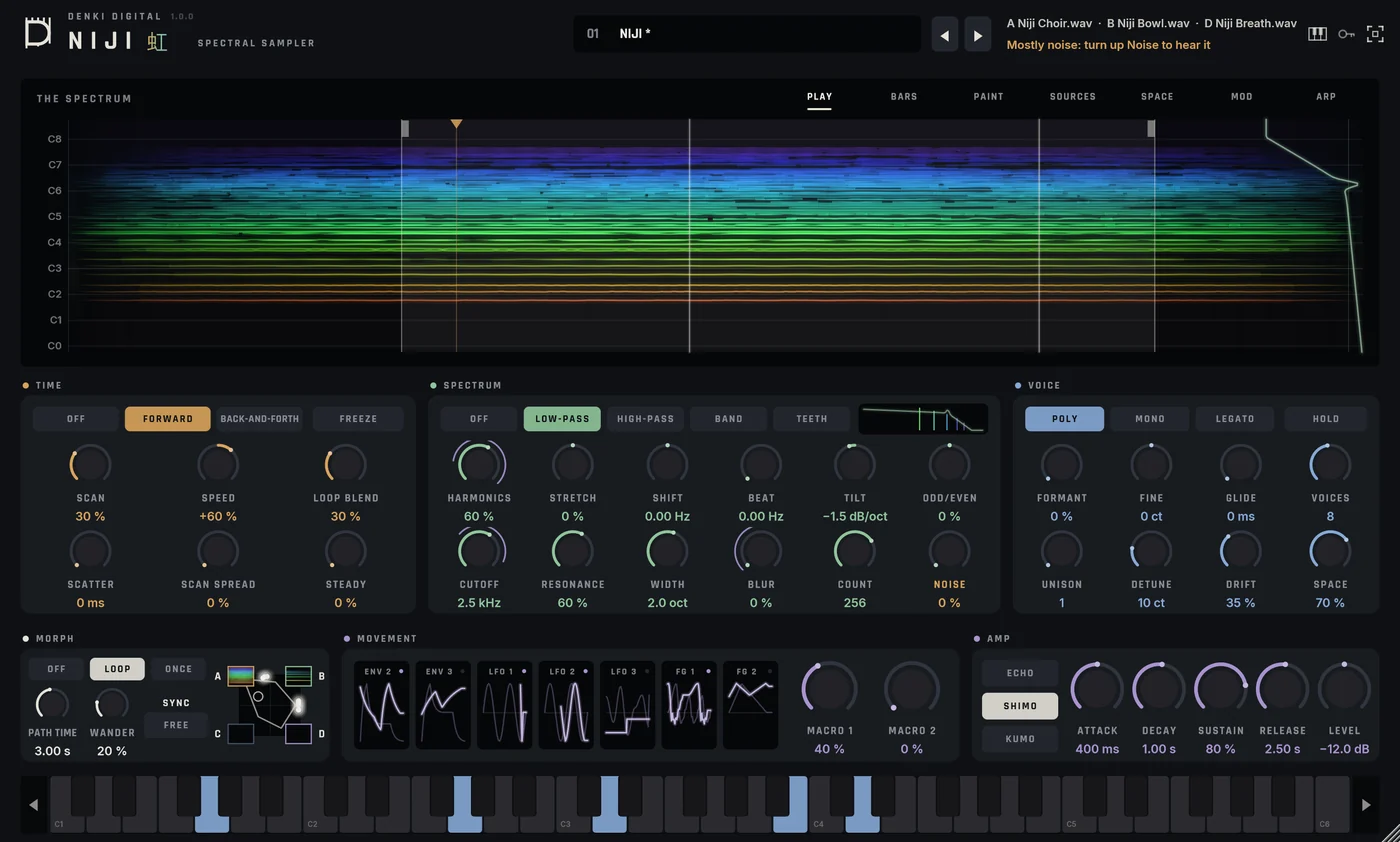
Niji is a spectral sampler. Drop a sound in and Niji writes it down as a few hundred sine partials and the noise between them, then plays that description, so time, pitch and timbre come apart.
Character
Niji is the rainbow: white light split into its colours.
Niji does that to a sound. It splits it into its partials, lets you bend them, and puts them back together.
Hold a note for a minute, and it never sounds held.
Designer's notes
I've always admired past machines that did interesting things but never reached the mass market (usually because they cost more than your house). Niji is our take on an ultra-rare, boutique late-1980s hardware graphic/additive spectral workstation that could analyse acoustic instruments and let you redraw their partials. Drop in a sample, then freeze it, redraw its harmonics and morph it with up to three other sounds to your heart's content. Definitely one for those who love deep, evolving ambient sounds.
— Stephen Widden, Aberdeen
Listen
One take, played in Live with the knobs moved by hand, on an orchestral pluck. Niji ships no sounds; it works on yours.
Exported from Live, matched in loudness. Nothing added afterwards.
What it does
A sound, written down
Drop in a WAV, AIFF, FLAC, Ogg or MP3 of up to a minute. Niji finds its pitch, its partials and the breath and noise between them, and plays those, never the recording. The project keeps what it found, so it opens anywhere without the file.
Time and pitch apart
Slow a sound down, stop it, or play it backwards, and its pitch stays. Play it an octave up and it keeps its length; Formant keeps a voice's vowel where it was.
Freeze
Hold one moment of a sound still, every partial and its noise, with no grains and no flutter. Scatter turns a frozen moment into a cloud of its own past and future.
The partials themselves
Pull them into perfect harmony, stretch them into bells, shift them into metal, give each a slow twin to beat against, comb them with the Spectral Filter, smear them with Blur, thin them with Count.
Four sounds in one field
Up to four sounds sit at the corners of the Morph field, and between them their partials meet and blend. Move the point by hand, round a path you draw, by a slow random wander, or from the matrix.
Alive when held
Drift moves each partial's pitch and level on its own; Space gives each its own place in the stereo field, wandering there. Unison, Scan Spread and Hold for chords and drones.
Bars and Paint
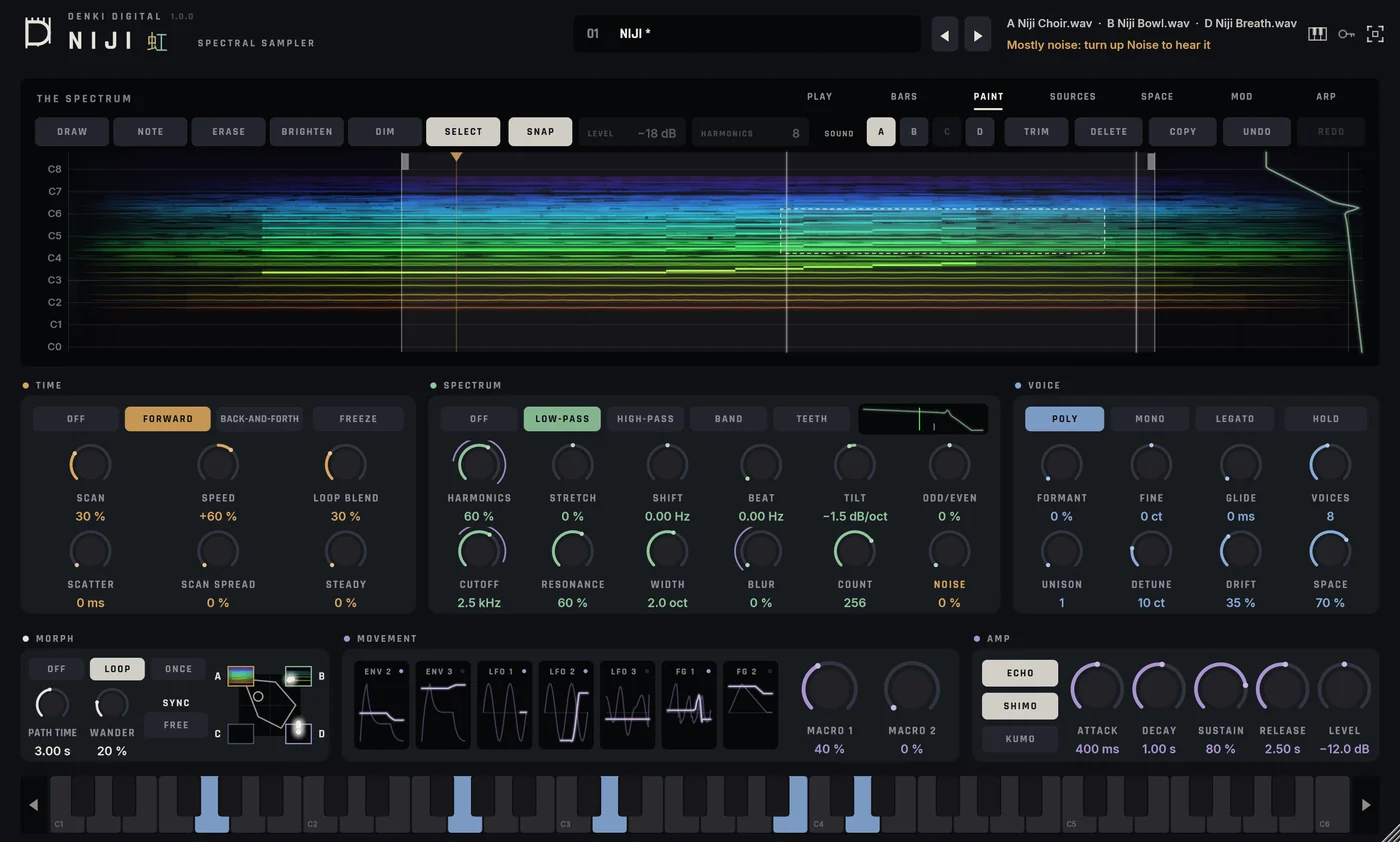
Thirty-two columns set each harmonic's level and tuning, like drawbars. Or paint on the sound itself: draw partials and whole notes, erase, brighten, dim, move and copy, with fifty steps of undo.
Movement
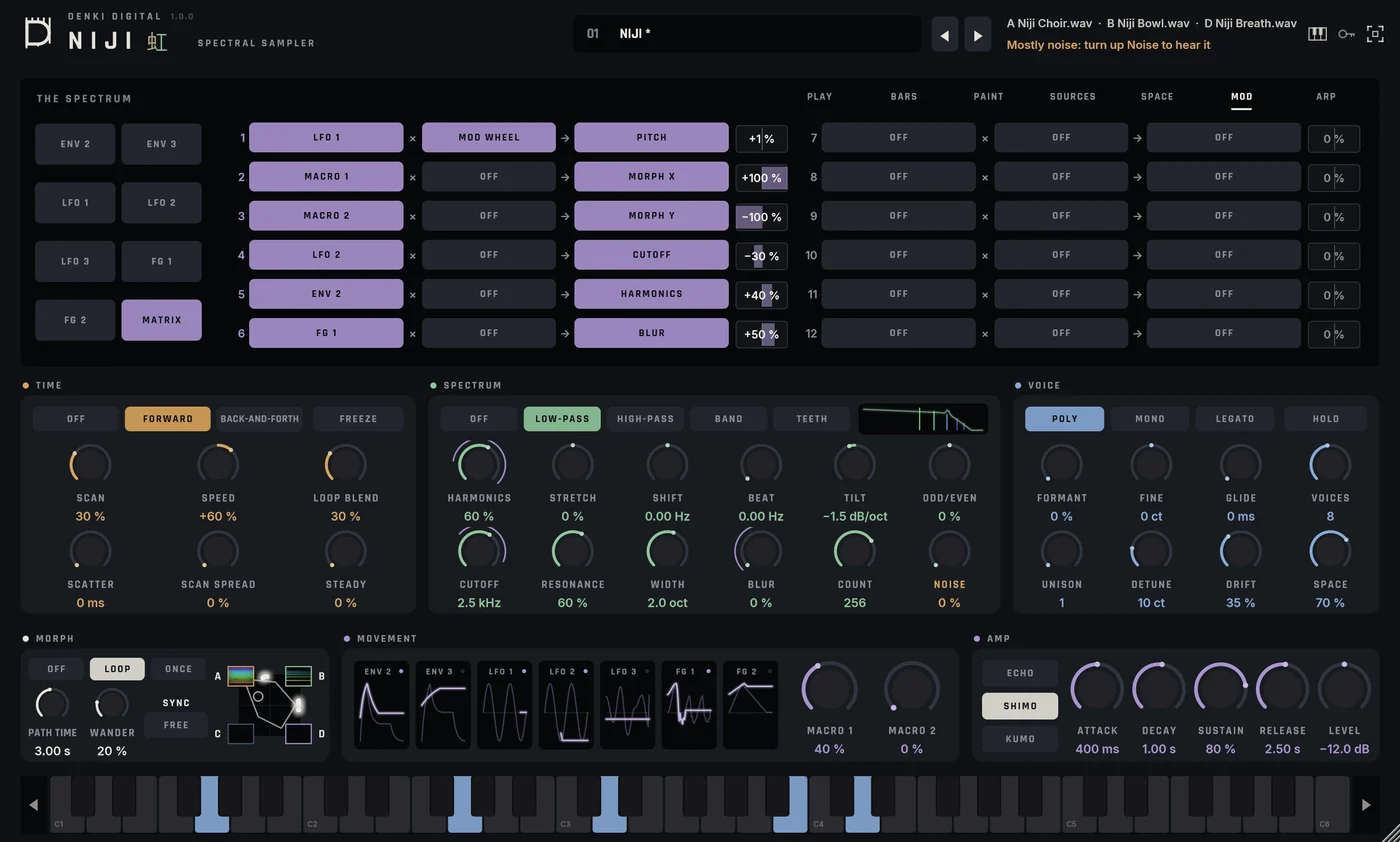
Two envelopes beside Amp's, three LFOs from eight minutes a cycle, two function generators, a twelve-slot matrix and two macros, each drawn live. And the Denki Digital arpeggiator and chord generator.
Denki Digital's spaces inside
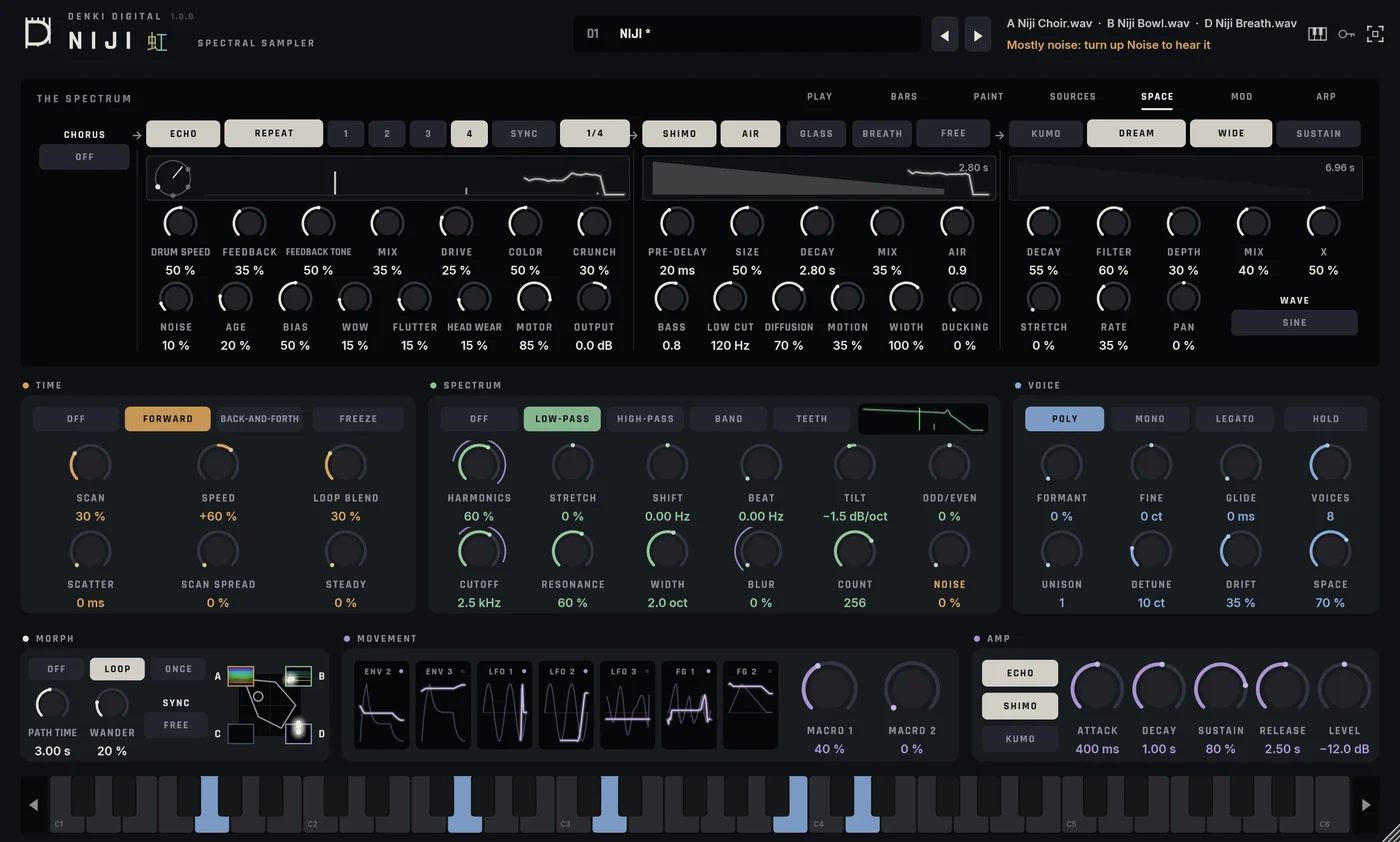
A chorus, Kodama's drum echo, and the reverbs of Shimo and Kumo: each the engine of its own instrument.
Views
Technical
| Type | Spectral resynthesis sampler |
|---|---|
| Sources | Four, A to D: WAV, AIFF, FLAC, Ogg or MP3, up to 60 s each, read as partials and 32 bands of noise; the project keeps the analyses, not the files |
| Partials | 16 to 512 at once, loudest first |
| Voices | 1 to 16, Poly, Mono or Legato; Unison up to 4 |
| Time | Scan, Speed (−200 to +200 %), Freeze, loops with Loop Blend, Scatter (to 2 s), Scan Spread, Steady |
| Spectrum | Harmonics, Stretch, Shift (±1 kHz), Beat (to 5 Hz), Tilt, Odd/Even, Spectral Filter with Resonance, Blur, Count, Noise |
| Morph | Four corners; a drawn path, looping or once, free or 1 to 16 bars; Wander |
| Modulation | Amp envelope, Env 2 and 3, 3 LFOs, 2 function generators, 12-slot matrix, 2 macros |
| Editing | Bars (32 columns, level and detune), Paint with 50 steps of undo |
| Performance | Arpeggiator and chord generator, Hold, on-screen keys |
| Effects | Chorus, Kodama's drum echo, Shimo's and Kumo's reverbs |
| Factory programs | 64, in eight groups, plus Init: treatments for your own sounds. Niji ships no sounds |
| Latency | 42 samples (Kodama's echo), reported always |
| Output | Stereo |
| Panel | 1360 × 752 (818 with the keys), scalable from 60 to 160% |
| Format | VST3, and Audio Unit on the Mac · Windows 10 or 11, 64-bit, or macOS 12 or later (Apple silicon or Intel) |
| Manual | The owner's manual, as a PDF |
From the factory programs
Also in the studio
Henge
変化 · transformationA synthesizer built around one morphing filter, which moves through forty-eight models of vowels, resonances and metal as you play.
Enter Airy ReverbShimo
霜 · frostA bright, clear reverb whose highs last as long as its middle, with a hall, a plate and a close halo that helps dry sounds breathe.
Enter Stereo Ambient ReverbKumo
雲 · cloudA stereo reverb for long ambient tails and slow blooms, with five algorithms that range from dark and heavy to bright and shimmering.
Enter