
Kiseki
軌跡the path traced
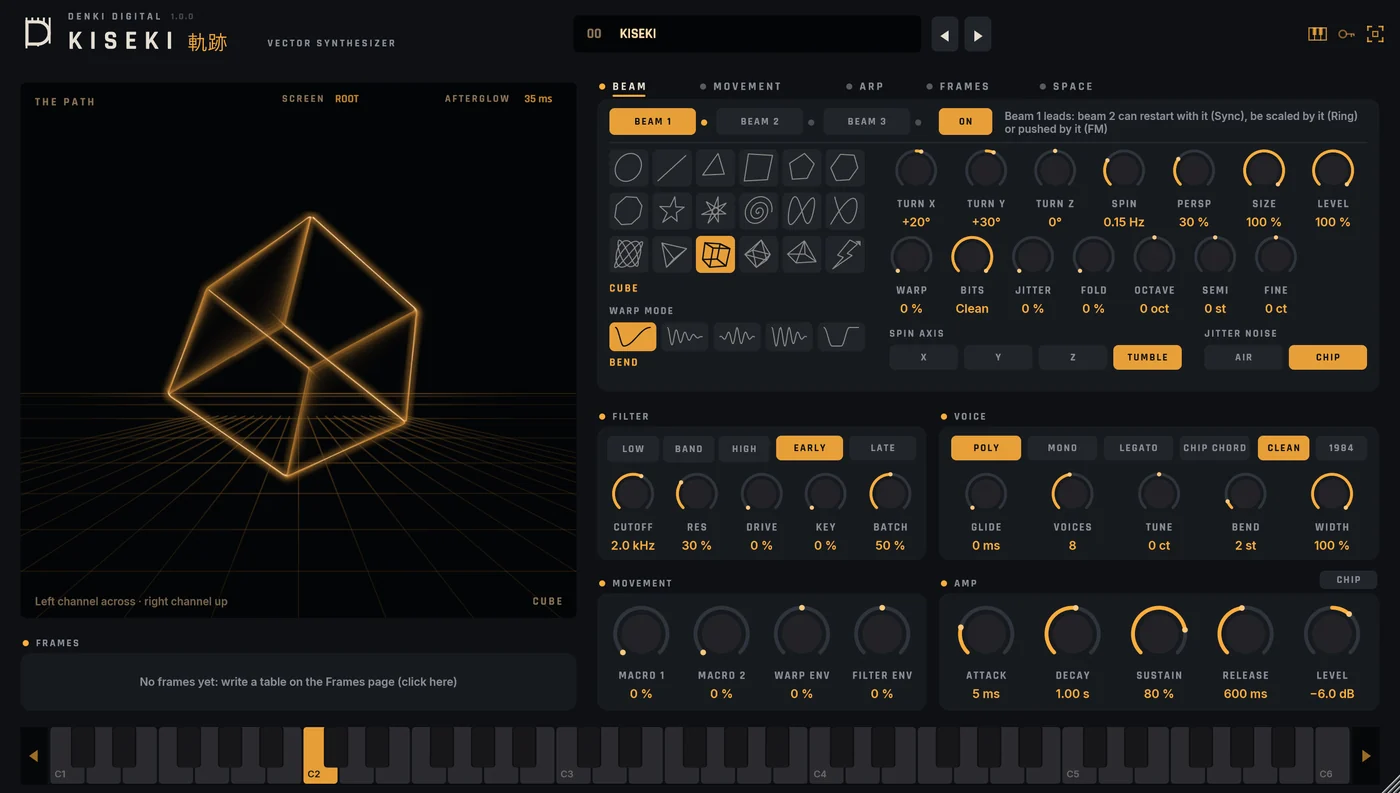
Kiseki is a vector synthesizer. Its screen is its sound: the left channel draws across, the right draws up, so the shape on the screen and the wave you hear are one thing.
Character
Kiseki is the path traced: the line a moving point leaves behind.
Here the point is the sound. Its left channel moves it across, its right moves it up, and the screen keeps its light.
Turn a cube, and you hear it turn.
Designer's notes
I was wondering what an old phase-distortion synth, paired with a 1980s home computer's sound chip and an FM engine, would sound like, as you do. Also, if the sound could be represented in 1980s arcade-style vector graphics, even better! And so, Kiseki was born. I love this one for the sheer sonic range it's capable of, and the chip jitter texture through a massive reverb is just pure ear candy.
— Stephen Widden, Aberdeen
Listen
One take, played in Live with the knobs moved by hand.
Exported from Live, matched in loudness. Nothing added afterwards.
What it does
The screen is the sound
The figure you see is the wave you hear, drawn with the light a real beam leaves: where the beam slows it glows, where it races it is faint. Turn a shape, spin it, set it in perspective, and its tone turns with it.
Seventeen shapes, and your own
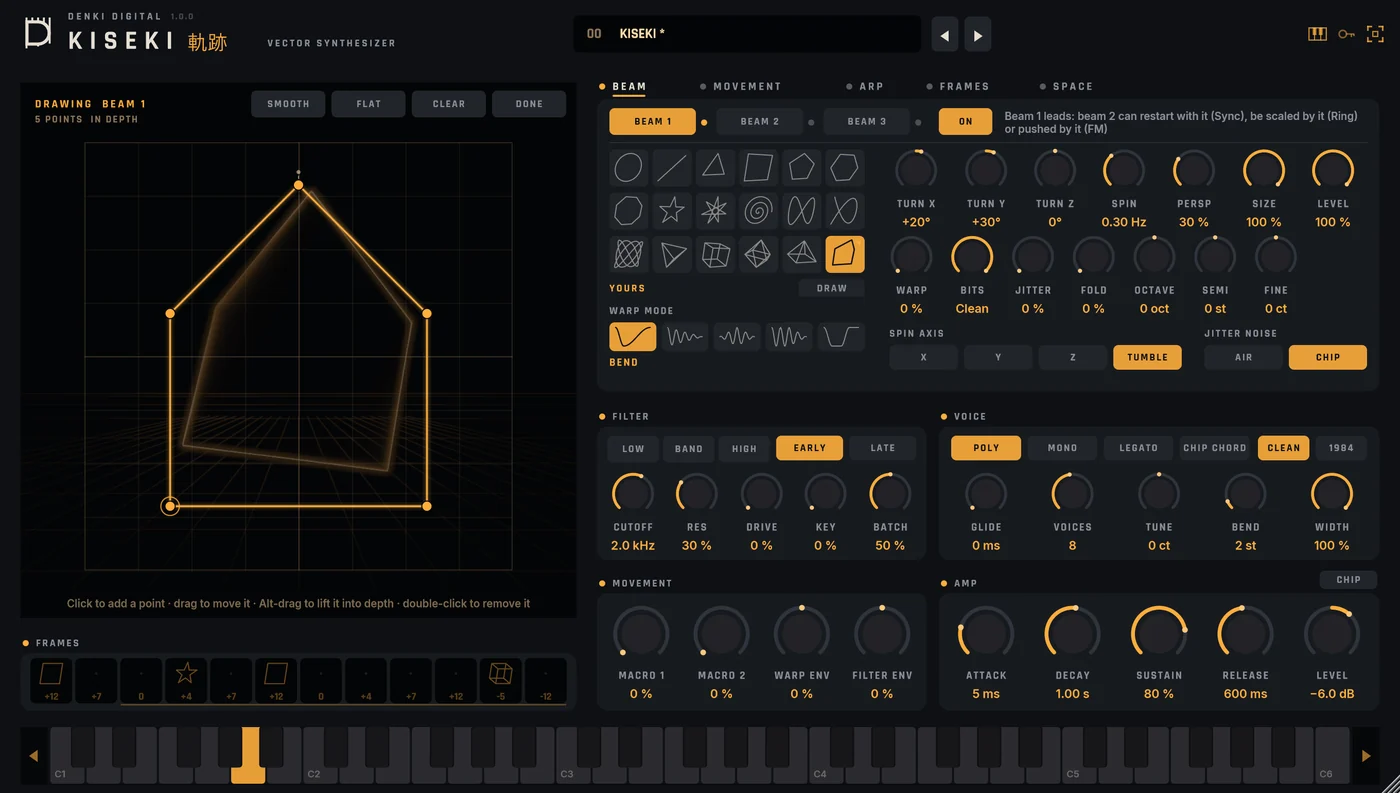
From a circle's two pure sines to the corners of a cube, a star or a Lissajous figure. Or draw your own point by point over the screen, flat or lifted into depth, and play it as you draw.
Warp
The trick of the 1980s phase-distortion keyboards: the beam's speed bent round its path, so a circle becomes a saw, a resonant sweep or a pulse. Five modes, clean at every pitch.
Three beams
Three beams in every voice, each its own shape, turn and warp. The second can restart with the first, be scaled by it or be pushed along its path by it (FM: bells, glass, metal, electric pianos), the third by the second, side by side on the screen.
Fold
Drive a beam past the edge of the screen and it folds back on itself, its corners knotting into petals: from a soft brightening to a bright, metallic buzz, the harmonics moving as the fold moves.
The chip inside
The home computer's sound chip, as its filter was early and late: its floor, its growl, its dirt, with Batch for one chip's character over another's. Its noise, its envelope's own steps, and the 1984 converter's twelve bits.
Frame tables
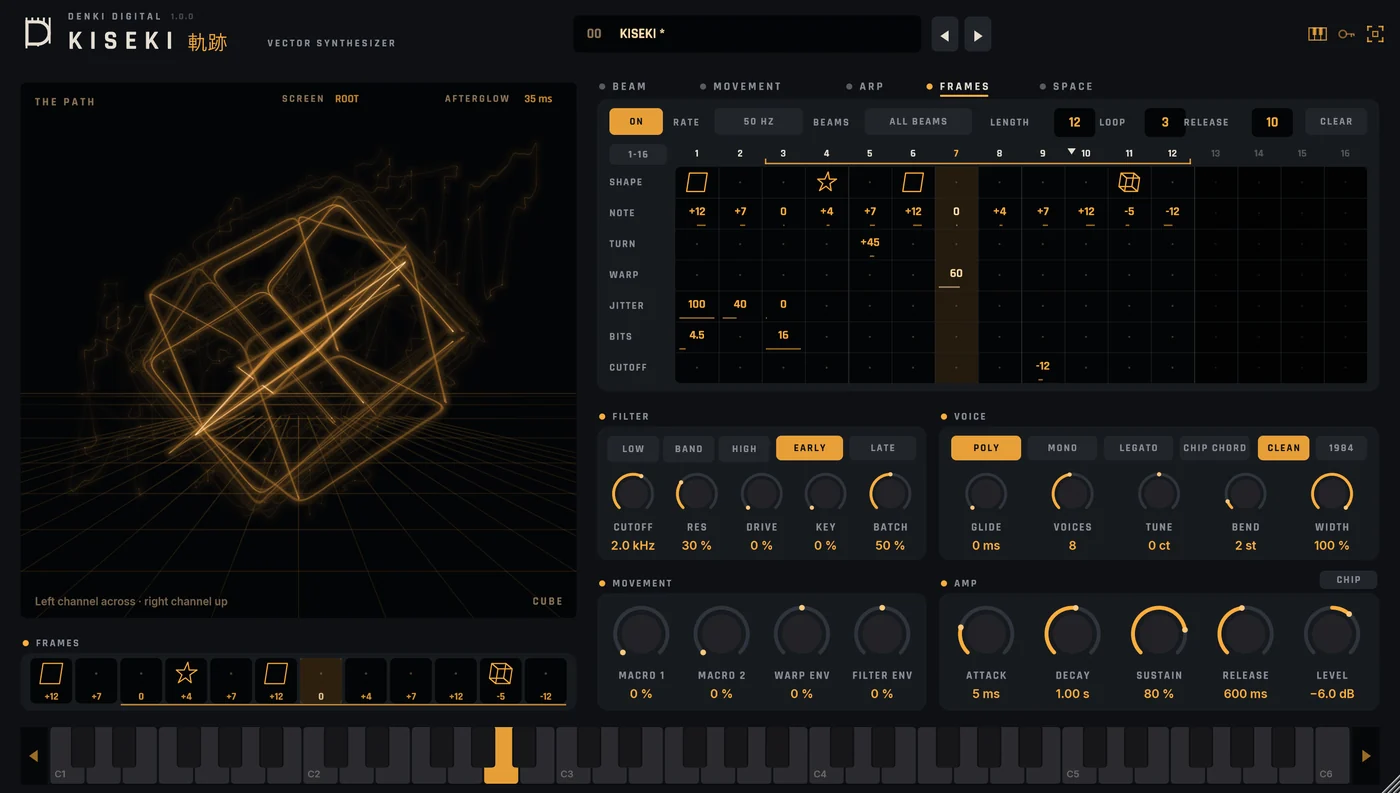
The trick behind most home-computer music: a short table stepped fifty times a second, changing the shape, the note or the noise every frame. The chip arpeggio, the drum of noise and a falling tone, the shape that flickers. And Chip Chord: one voice flicking through a chord.
Movement
A Warp envelope and a Filter envelope beside Amp's, three LFOs, a twelve-slot matrix and two macros, each drawn live. And the Denki Digital arpeggiator and chord generator.
Denki Digital's spaces inside
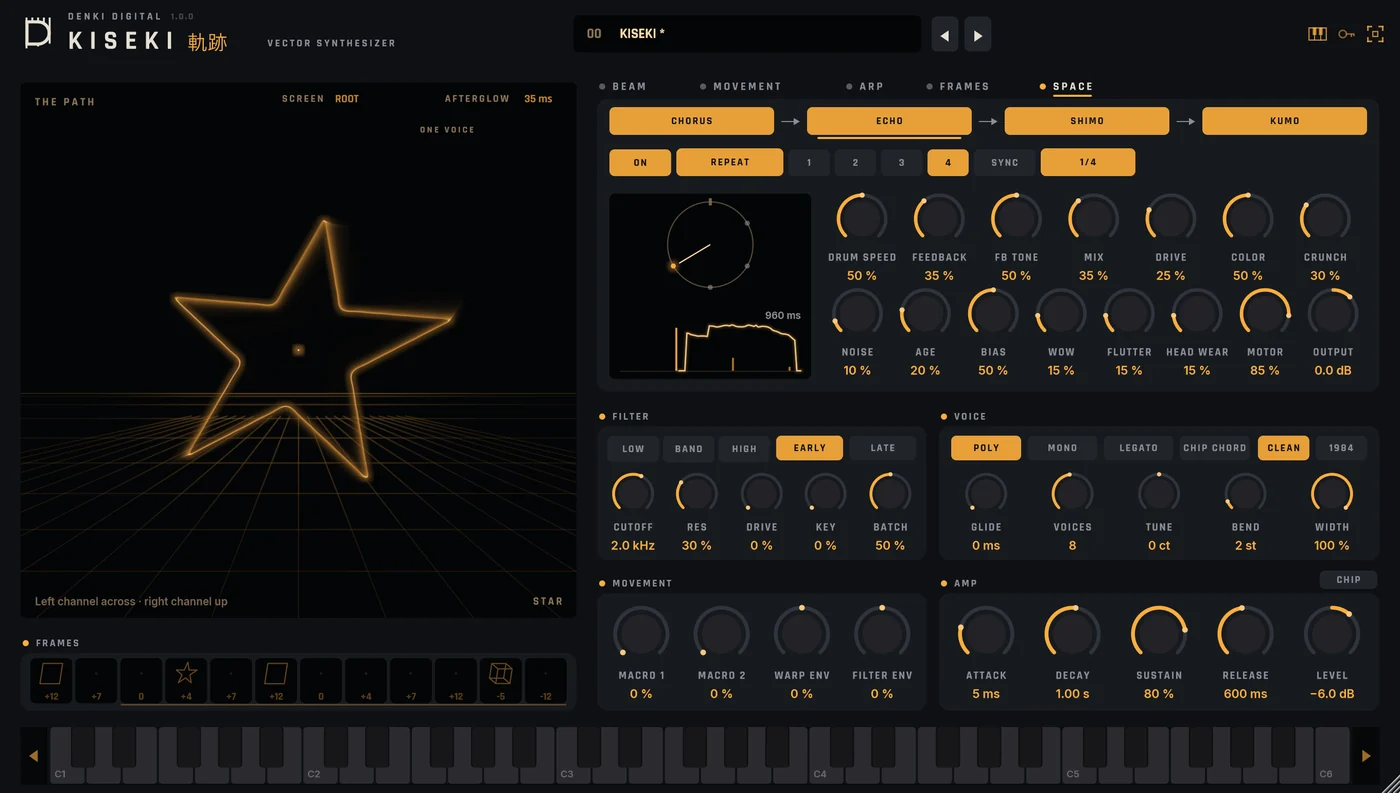
A chorus, Kodama's drum echo, and the reverbs of Shimo and Kumo: each the engine of its own instrument.
Afterglow and One Voice
Hold the beam's light from a few milliseconds to four seconds. When the sound stops, the last figure fades rather than vanishing. While a chord sounds through the space, the screen keeps to its root, drawn alone and clean, and a small view to the newest note; or show every note, or the sound as heard.
Views
Technical
| Type | Vector synthesizer |
|---|---|
| Beams | Three a voice, each one of 17 shapes or your own drawing; sync, ring and FM between them |
| Shapes | Circle, Line, Triangle, Square, Pentagon, Hexagon, Octagon, Star, Star 7, Spiral, three Lissajous figures, Tetrahedron, Cube, Octahedron, Pyramid; your own of up to 64 points, in depth |
| Each beam | Turn X, Y and Z, Spin (to 10 Hz) about X, Y, Z or a tumble, Perspective, Size, Warp in five modes, Bits, Jitter (Air or Chip noise), Fold, Octave, Semi, Fine, Level; FM Depth (beams 2 and 3) |
| Filter | Low, band and high, alone or together; Early and Late characters; Cutoff, Resonance, Drive, Key Follow, Batch |
| Voices | 1 to 16, Poly, Mono, Legato or Chip Chord; Glide, Width; the converter Clean or 1984 |
| Modulation | Amp envelope (with the chip's own timing), Warp and Filter envelopes, 3 LFOs, 12-slot matrix, 2 macros |
| Frame tables | Up to 32 steps at 50 or 60 a second or a note value of the tempo, with a loop and a release step |
| Performance | Arpeggiator and chord generator, on-screen keys |
| Effects | Chorus, Kodama's drum echo, Shimo's and Kumo's reverbs |
| The screen | The sound itself, left across and right up: the root note alone, every note, or as heard; Afterglow to 4 s; One Voice |
| Factory programs | 12 atmospheres, plus Init |
| Latency | 42 samples (Kodama's echo), reported always |
| Output | Stereo |
| Panel | 1360 × 704 (770 with the keys), scalable from 60 to 160% |
| Format | VST3, and Audio Unit on the Mac · Windows 10 or 11, 64-bit, or macOS 12 or later (Apple silicon or Intel) |
| Manual | The owner's manual, as a PDF |
From the factory programs
Also in the studio
Kosen
光線 · a beam of lightAn eight-part wavetable synthesizer in the spirit of the eighties' wavetable machines, with sixty-four tables and a filter that can scream.
Enter Magnetic Drum EchoKodama
木霊 · the echo that answers from the treesAn echo modelled on a spinning magnetic drum, with four playback heads, a drive stage in front and a spring reverb beside it.
Enter Airy ReverbShimo
霜 · frostA bright, clear reverb whose highs last as long as its middle, with a hall, a plate and a close halo that helps dry sounds breathe.
Enter