
Hotaru 240
蛍firefly
Hotaru 240 is an eight-voice DCO polysynth: two oscillators, a brass circuit, an ensemble, and a panel that glows in the dark.
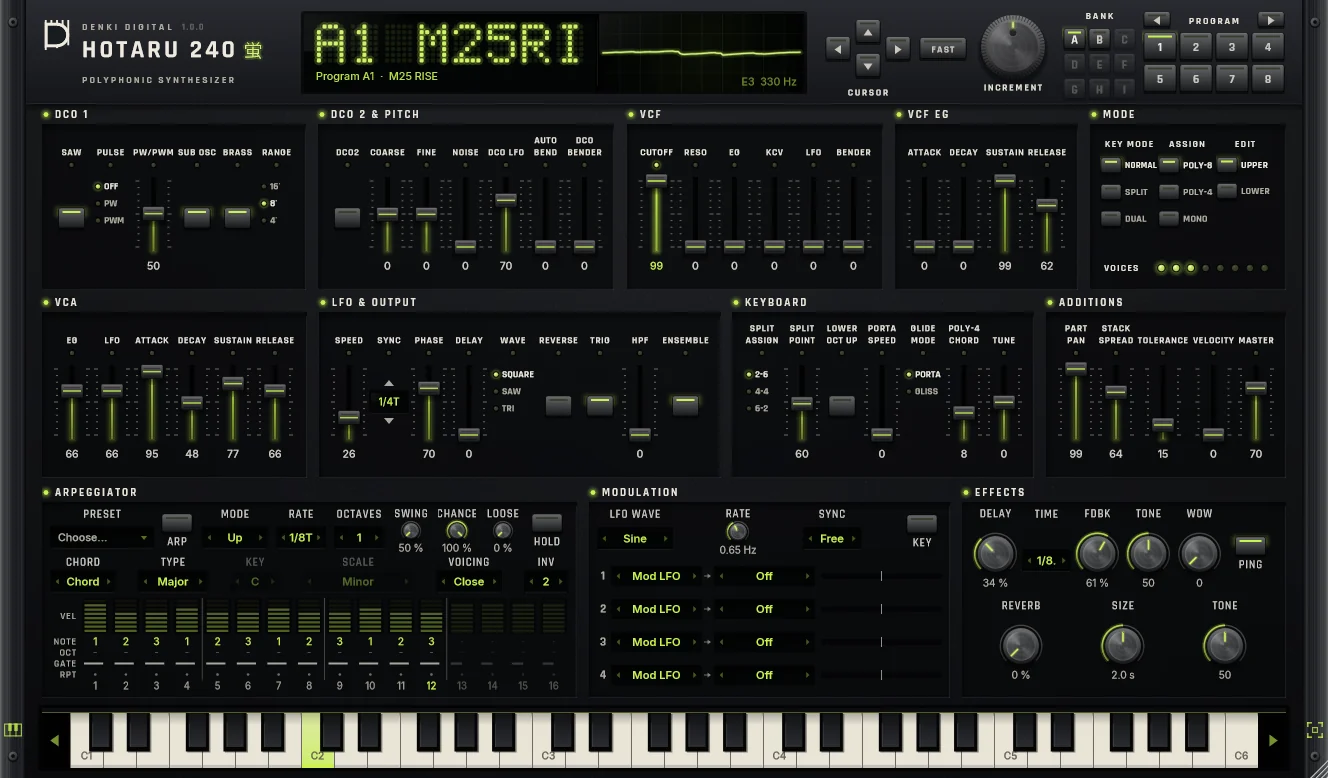
Character
Hotaru is the firefly.
The instrument it remembers glowed too: a green display in a black panel, a small light in a dark room.
Eight voices, a brass circuit, and an ensemble that turns a simple chord into a room full of light.
Lineage · A Japanese eight-voice polysynth of 1984, and its glowing display.
Designer's notes
As you can tell, I'm an admirer of Japanese culture and especially the many wonderful electronic instruments designed there over the years. This one is inspired by a rare and, sadly, overlooked eight-voice polyphonic analogue synthesizer released in 1984. Some may say that this synth did many things better than its more popular contemporaries, so here's its chance to shine in a new era.
— Stephen Widden, Aberdeen
What it does
Two oscillators
Saw and pulse with a sub-octave on the first; a square on the second, tuned in fine steps.
Brass
A gate that lets the saw through only while the second oscillator is high. A hollow, reedy edge of its own.
Ensemble
Three bucket-brigade lines at two speeds, after the original's ensemble board.
The filter
A 24 dB low-pass in the manner of a classic chip, one on every voice, singing at the top.
Poly-8, Poly-4, Mono
Stack two voices to a note with a chord memory, or all eight on one. Split or layer two tones.
LFO Trig
The LFO retriggers the envelopes, synced to your host from two bars to a thirty-second, on the beat or moved off it.
Arpeggiator and chords
Nine modes, sixteen steps, fifty-nine patterns.
Effects
Tape delay and reverb, after the ensemble.
Views
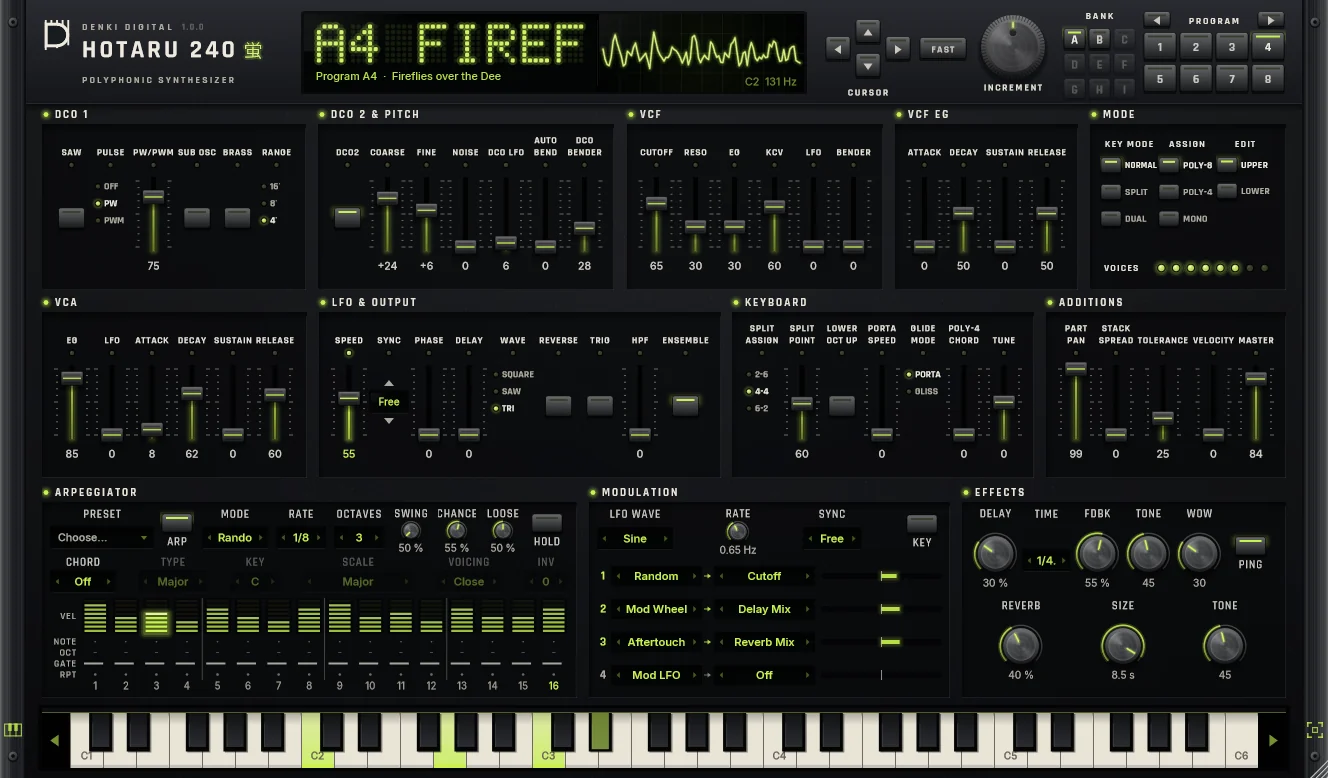
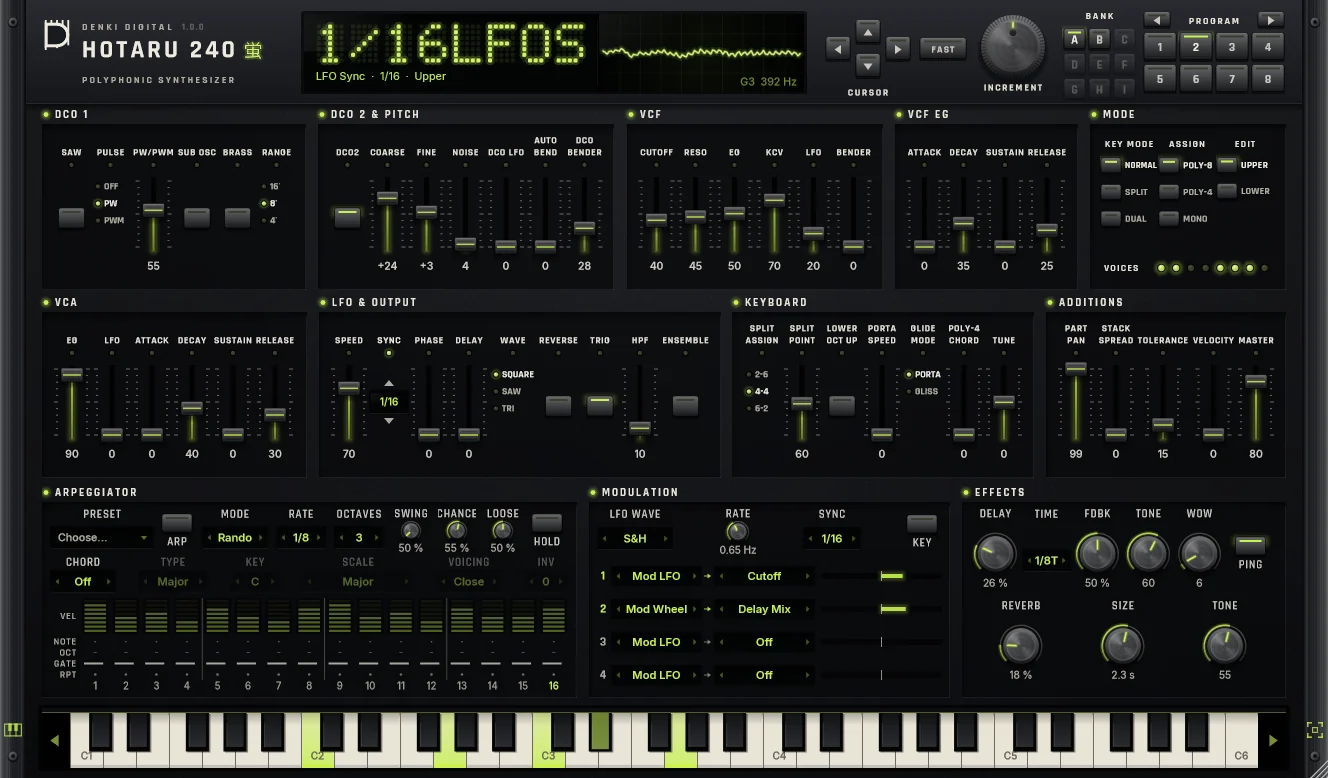
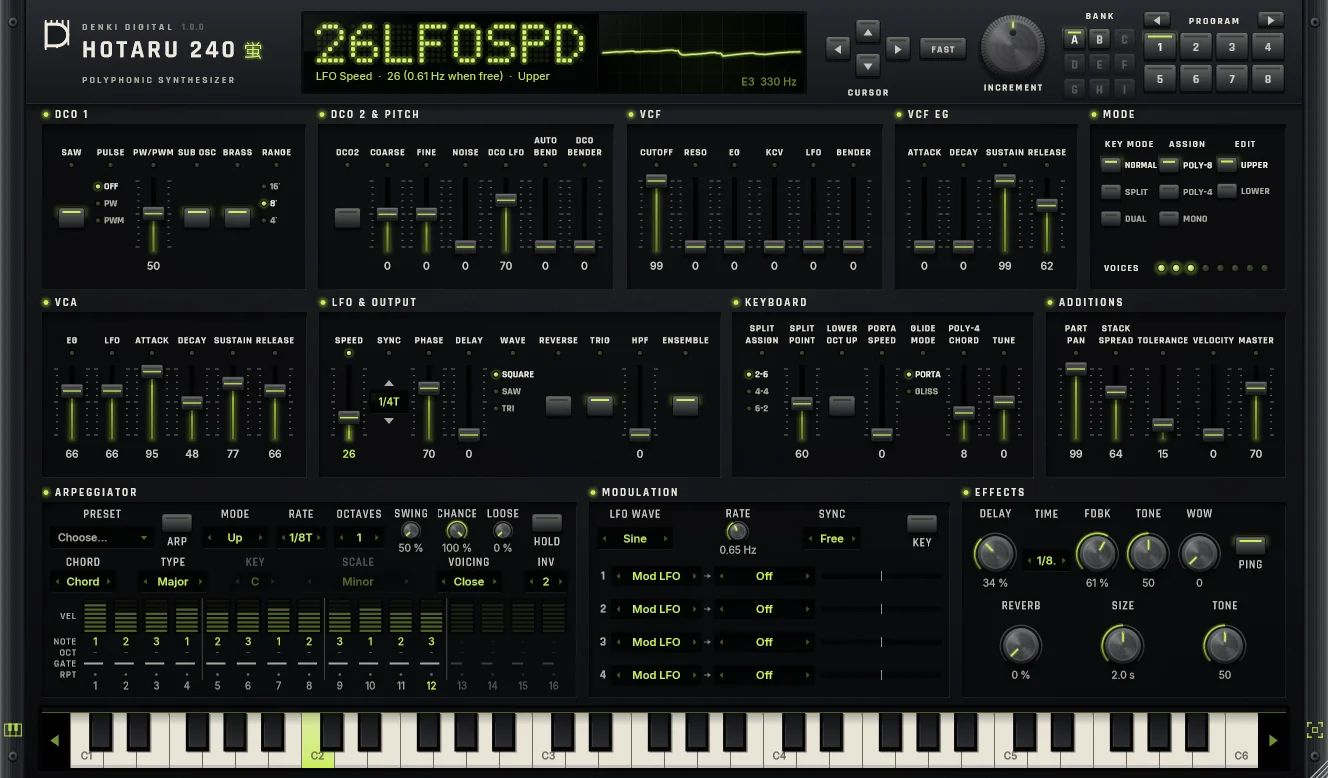
Technical
| Voices | 8; Poly-8, Poly-4 and Mono |
|---|---|
| Key modes | Normal, Split (adjustable), Dual |
| Oscillators | DCO 1: saw, pulse, sub; DCO 2: square; brass gate; noise |
| Filter | 24 dB low-pass per voice, self-oscillating |
| Envelopes | 2 ADSR |
| LFO | Square, saw, triangle; delay, reverse, trig, host sync with a phase offset |
| Modulation | Mod LFO and a 4-slot matrix |
| Chorus | Three-line ensemble |
| Effects | Tape delay, reverb |
| Factory programs | 12, plus Init |
| CPU | 2.2% of one core; 2.3% with effects and modulation |
| Output | Stereo |
| Panel | 1328 × 778, scalable from 60 to 160% |
| Format | VST3, and Audio Unit on the Mac · Windows 10 or 11, 64-bit, or macOS 12 or later (Apple silicon or Intel) |
| Manual | The owner's manual, as a PDF |
From the factory programs
Also in the studio
Tsukumo 99
九十九 · ninety-nineA free six-voice hybrid polysynth with digital oscillators and a warm four-pole filter. It's where Denki Digital began.
Enter Six-Part Analog-Voice SynthesizerHyō
豹 · leopardA six-part synthesizer built on a model of a classic analogue voice chip, with two oscillators, a four-pole filter and three envelopes in every voice.
Enter Stereo Ambient ReverbKumo
雲 · cloudA stereo reverb for long ambient tails and slow blooms, with five algorithms that range from dark and heavy to bright and shimmering.
Enter