
Henge
変化transformation
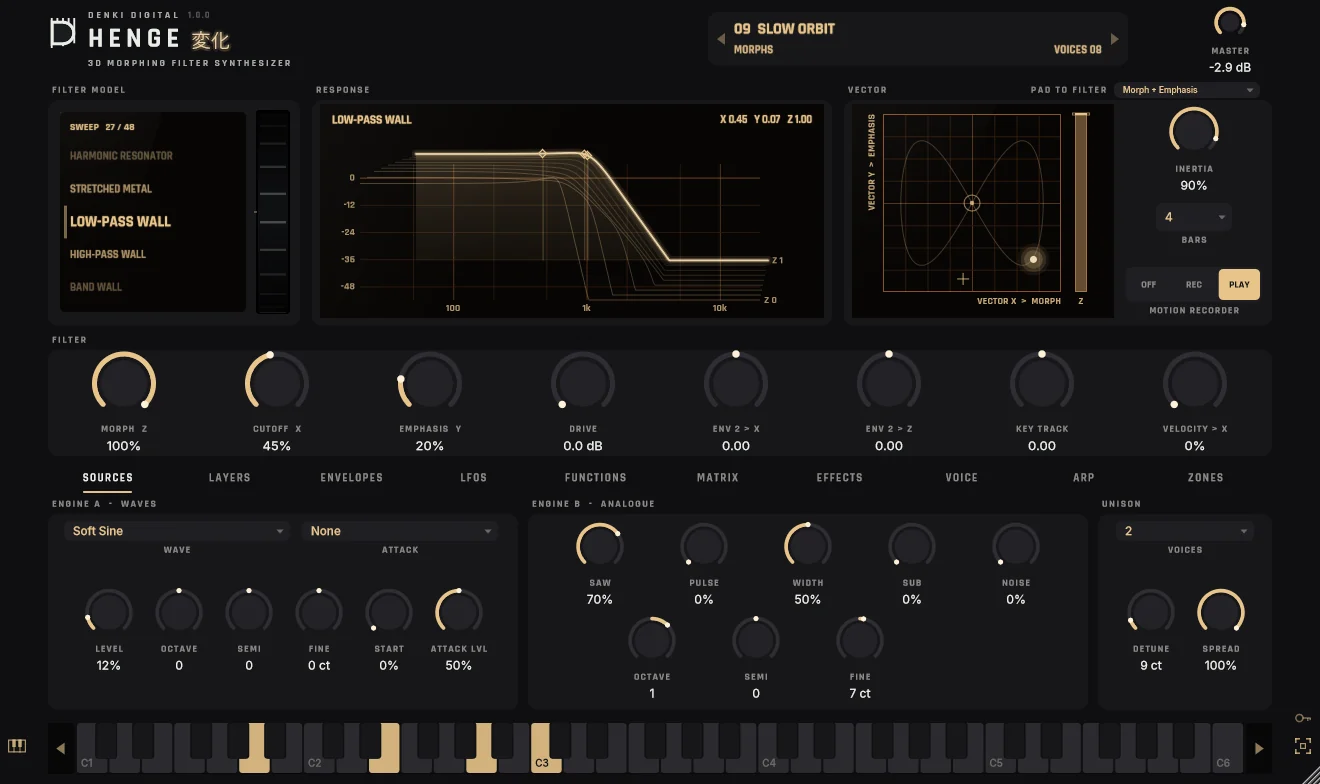
Henge is a morphing-filter synthesizer. At its heart is a fourteen-pole filter that moves between vowels, resonances and metal as you play.
Character
In Japanese, henge is a shapeshifter: a spirit that takes one form, and then another.
A pad becomes a voice. A voice becomes a bell. A sweep passes through a throat, a comb, a sheet of glass.
Move the pad, and the sound follows you.
Lineage · The morphing-filter rack modules of the early nineties.
Designer's notes
There's a certain early-1990s digital rackmount synthesizer that I always wanted, mainly for its sound-morphing capabilities, ideal for shifting and evolving timbres. They command a king's ransom on the used gear market these days, so we built our own, adding features the original lacked whilst keeping the character and spirit of the classic unit alive. It's no one-trick pony, though: it can produce a wide range of sounds, from lush pads to cutting leads.
— Stephen Widden, Aberdeen
Listen
One take, played in Live with the knobs moved by hand.
Exported from Live, matched in loudness. Nothing added afterwards.
What it does
The morphing filter
Fourteen poles in seven resonant sections, steered by X, Y and Z. Forty-eight models in five families: Vocal, Resonator, Sweep, Comb and Character.
Two engines
A wave engine with its own library of single cycles, loops and attacks, and an analogue-style engine of saw, pulse, sub and noise. Up to four-voice unison.
Dual filters and layers
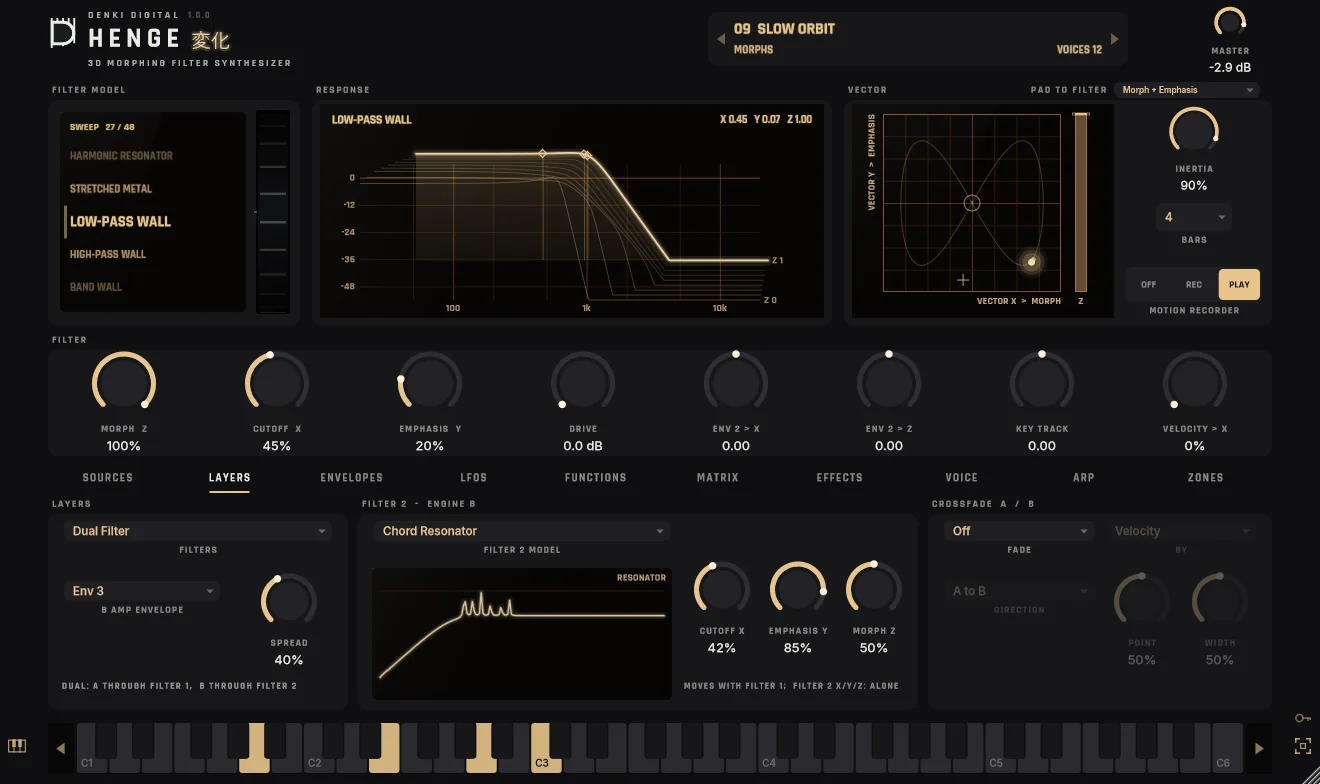
Give each engine its own filter, then crossfade or switch between them by velocity, key, wheel, pressure or the pad.
The vector pad
An X/Y pad with inertia, and a recorder that captures up to four bars of movement and loops it with your host.
Function generators
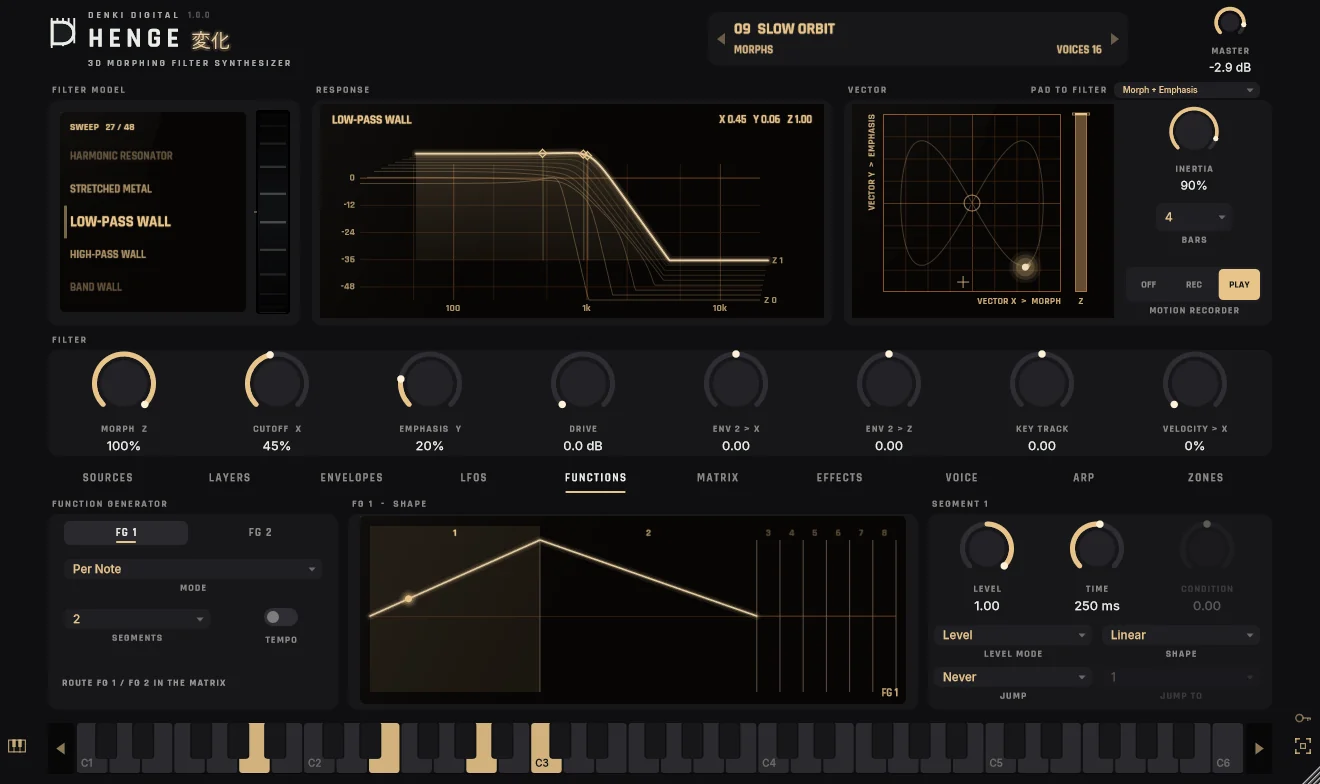
Two, of up to eight segments, with twenty-two shapes and conditional jumps. Motion with intent.
Zones
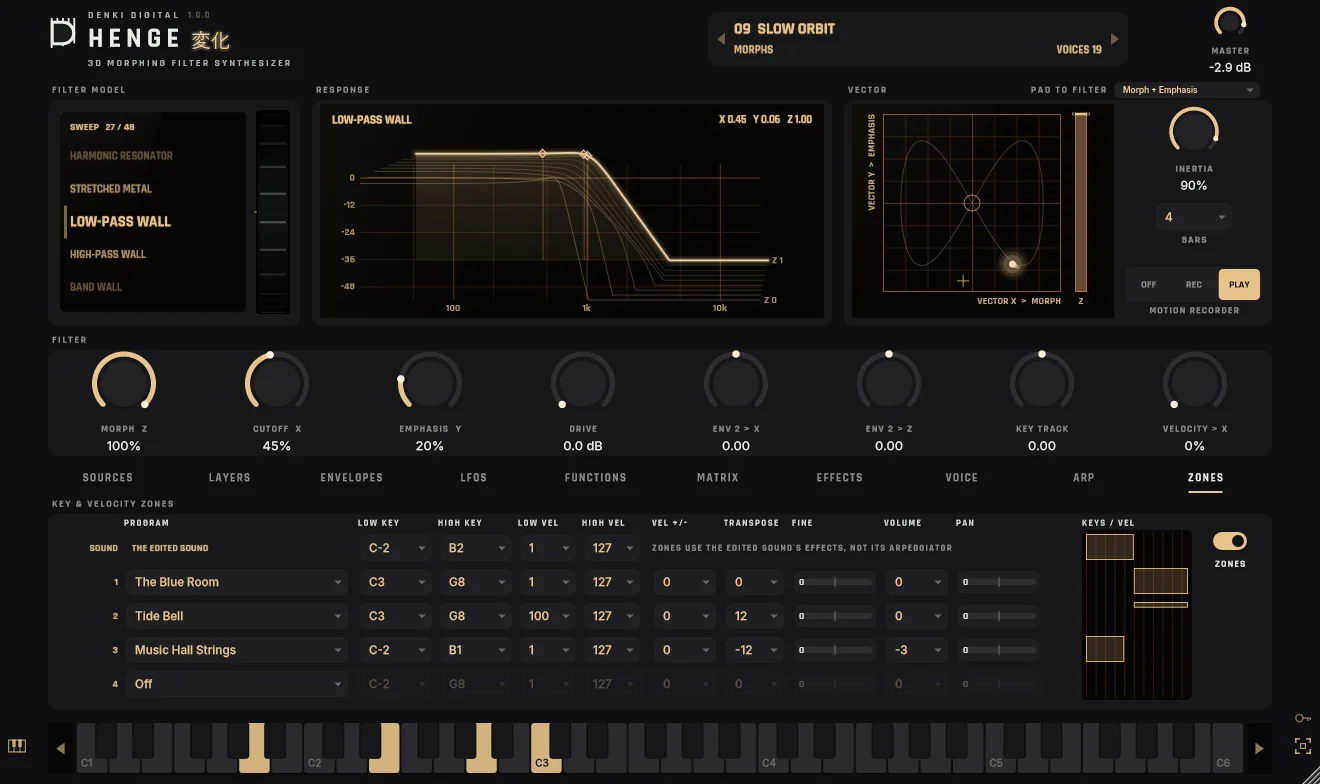
Split and layer up to four programs by key and velocity, each with its own tuning, level and pan.
Arpeggiator and chords
Fifty-nine patterns in five styles. Sixteen steps with ratchets and chance. Chord and scale modes.
Effects
A dual tape delay, and a plate reverb with a sixteen-bit vintage mode.
Views
Technical
| Voices | 1 to 16, or mono with legato and glide |
|---|---|
| Sound sources | Wave engine and analogue-style engine; unison up to 4 |
| Filter | 14-pole morphing filter, 48 models in 5 families; Single or Dual |
| Modulation | 3 envelopes, 2 LFOs, 2 function generators, 12-slot matrix |
| Performance | Vector pad with motion recorder, arpeggiator and chord generator, 4 zones |
| Effects | Dual tape delay, plate reverb, output limiter |
| Factory programs | 12, chosen by ear, plus Init |
| CPU | 3.2% of one core for 16 voices; under 10% with everything engaged |
| Latency | 71 samples (limiter lookahead) |
| Output | Stereo |
| Panel | 1320 × 784, scalable from 60 to 160% |
| Format | VST3, and Audio Unit on the Mac · Windows 10 or 11, 64-bit, or macOS 12 or later (Apple silicon or Intel) |
| Manual | The owner's manual, as a PDF |
From the factory programs
Also in the studio
Kosen
光線 · a beam of lightAn eight-part wavetable synthesizer in the spirit of the eighties' wavetable machines, with sixty-four tables and a filter that can scream.
Enter Cross-Wave Hybrid SynthesizerTasogare
黄昏 · twilightA hybrid synthesizer where digital waves feed an analogue-style voice, in four layers that can each sound eight-bit, twelve-bit or clean.
Enter Stereo Ambient ReverbKumo
雲 · cloudA stereo reverb for long ambient tails and slow blooms, with five algorithms that range from dark and heavy to bright and shimmering.
Enter