
Tsugime
継ぎ目the seam
Tsugime breaks sound with the music, not against it. Its wreckage rings at the song's pitches, falls on its grid, and is played with one control that walks a sound from clean to worn, to broken, to remade.
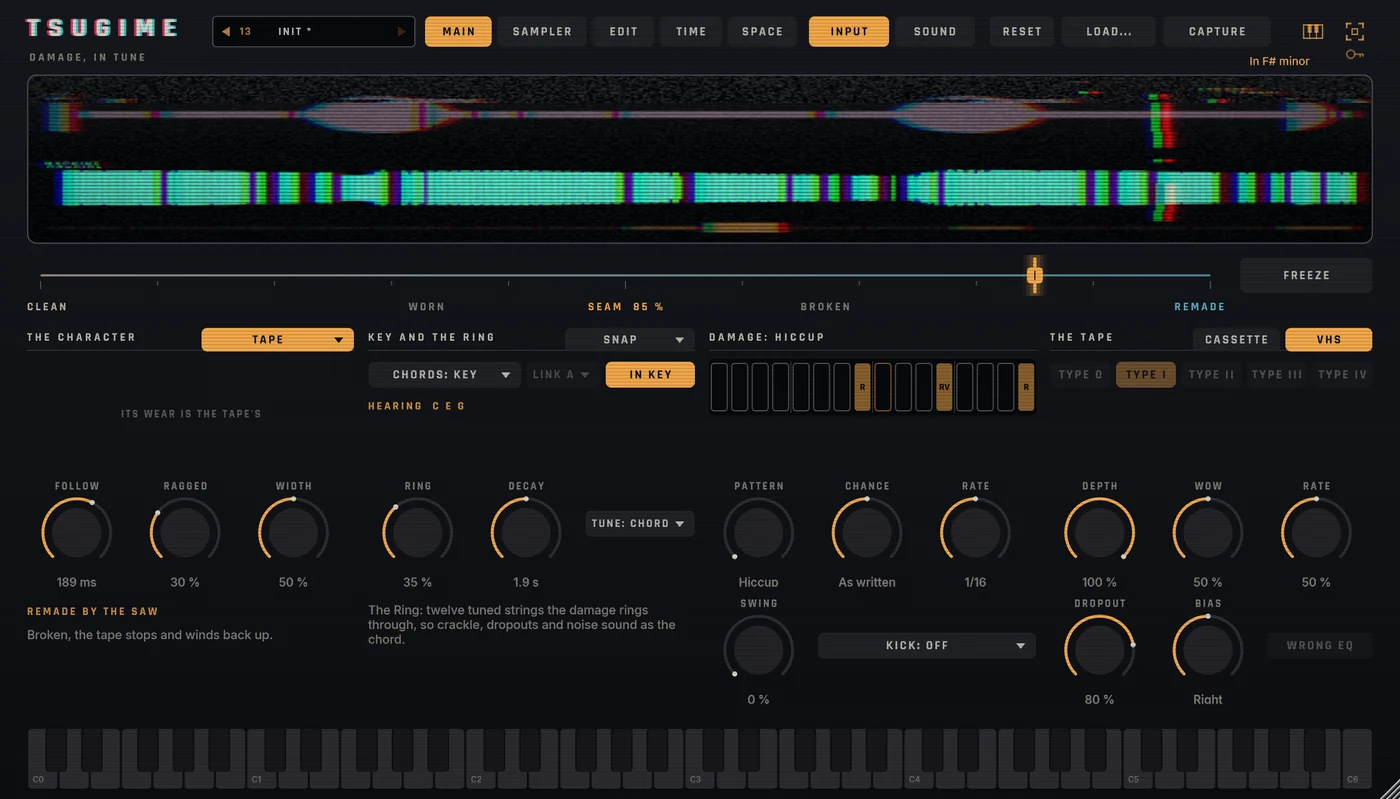
Character
Tsugime is the seam: the line where two things are joined.
Here it is the line between a sound and what a machine leaves of it, and it moves the whole way: clean, worn, broken, remade.
Every tape remembers the hand that recorded it.
Designer's notes
I love shifting, evolving, dreamy ambient soundscapes, but at the other extreme I also love the textures you find when you destroy a sound. Enter Tsugime: destruction, in tune. The concept: take a sound, feed it through a machine, and break it. The Seam control can be (ab)used like a DJ's crossfader, and it's awesome for mangling loops and breaks. It's ideal for any genre, but I can see industrial, electro and breakbeat musicians really enjoying this one.
— Stephen Widden, Aberdeen
What it does
One gesture
The Seam carries a sound the whole journey: clean, then worn by a machine and a tape, then broken, the machine failing, then remade, sung again in the key by the machine's own voice. Each stage glides into the next, the level held all the way.
Eight characters
Tape, Copier, Printer, Modem, Mains, Motor, Press and Chip: each a whole way of wearing a sound, breaking it, and remaking it with a saw, a choir or a home computer's sound chip. Change the character and the whole journey changes with it.
In key
The damage resolves to the music. A crush's folding lands on the note's own harmonics, a repeat short enough to buzz buzzes on a note of the chord, a tape stop lands an octave, a fifth or a fourth down instead of grinding to a halt.
The Ring
Twelve tuned strings the wreckage rings through, so crackle, dropouts and noise sound as the chord: the key's own, the notes you hold, or the chords Kiri is playing.
In time
A sixteen-step Damage sequencer on the host's grid: Repeat, Reverse, Stop, Crush, Drop, Pitch and Gate, each step with its own chance and amount, eight patterns from a hiccup to a wreck, and the steps can wait for Kaminari's kick or keep out of its way.
The sampler
Kept at 36, 18 or 9 kHz through the filter each rate sets, recorded on a trigger, loaded or captured, played from the keys. Crop it, save it, drag it onto a track, or resample Tsugime's own output and break it again. Stretch keeps its length whatever the key; Fit keeps a loop in whole bars.
The tape
Five cassette types, from basic ferric to metal, or a VHS sound track: wow, flutter, hiss, the treble going, dropouts, and a machine that ages as it runs, until Renew brings it back. Freeze holds what it has made and lets you play over it.
Denki Digital's spaces inside
Kodama's drum echo, then the reverbs of Shimo and Kumo, each the engine of its own instrument, with all its controls.
Views
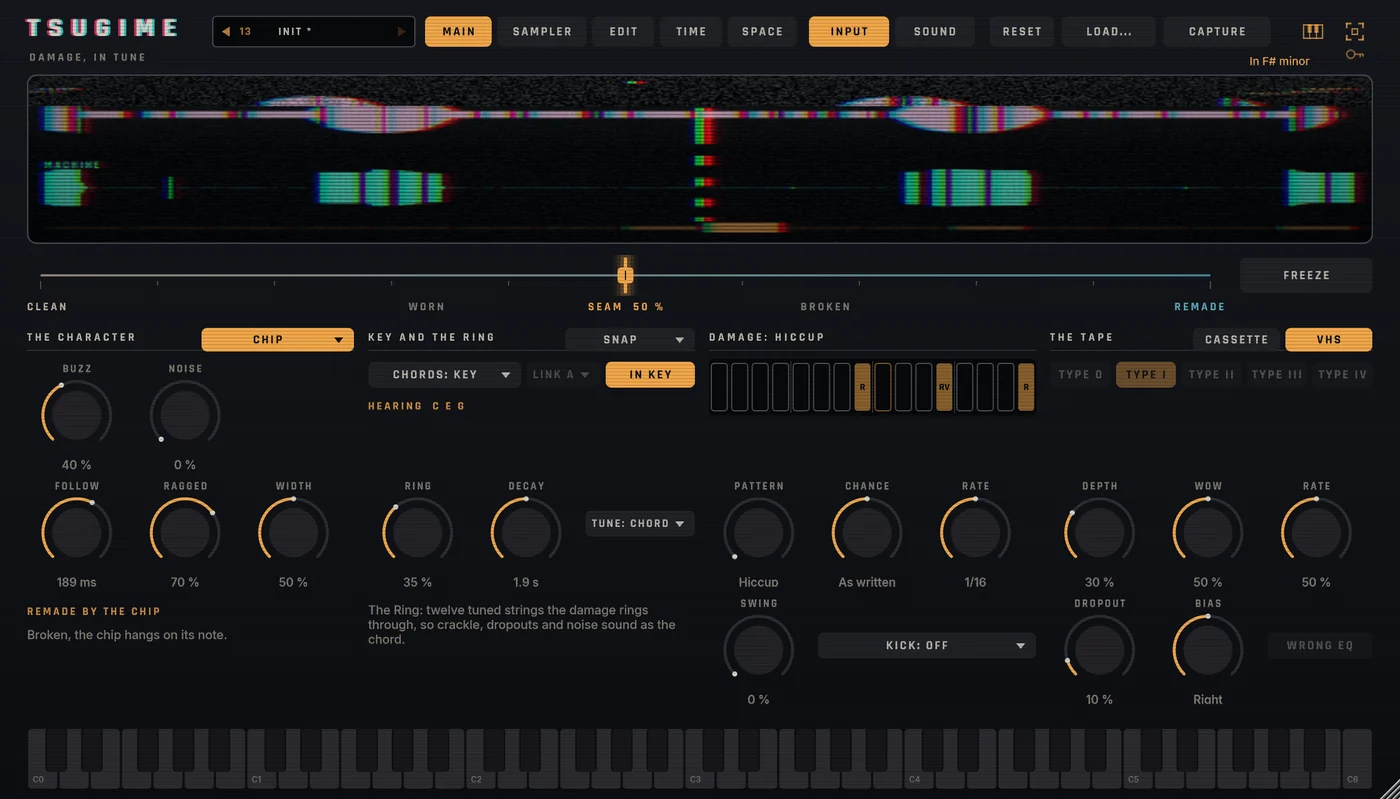
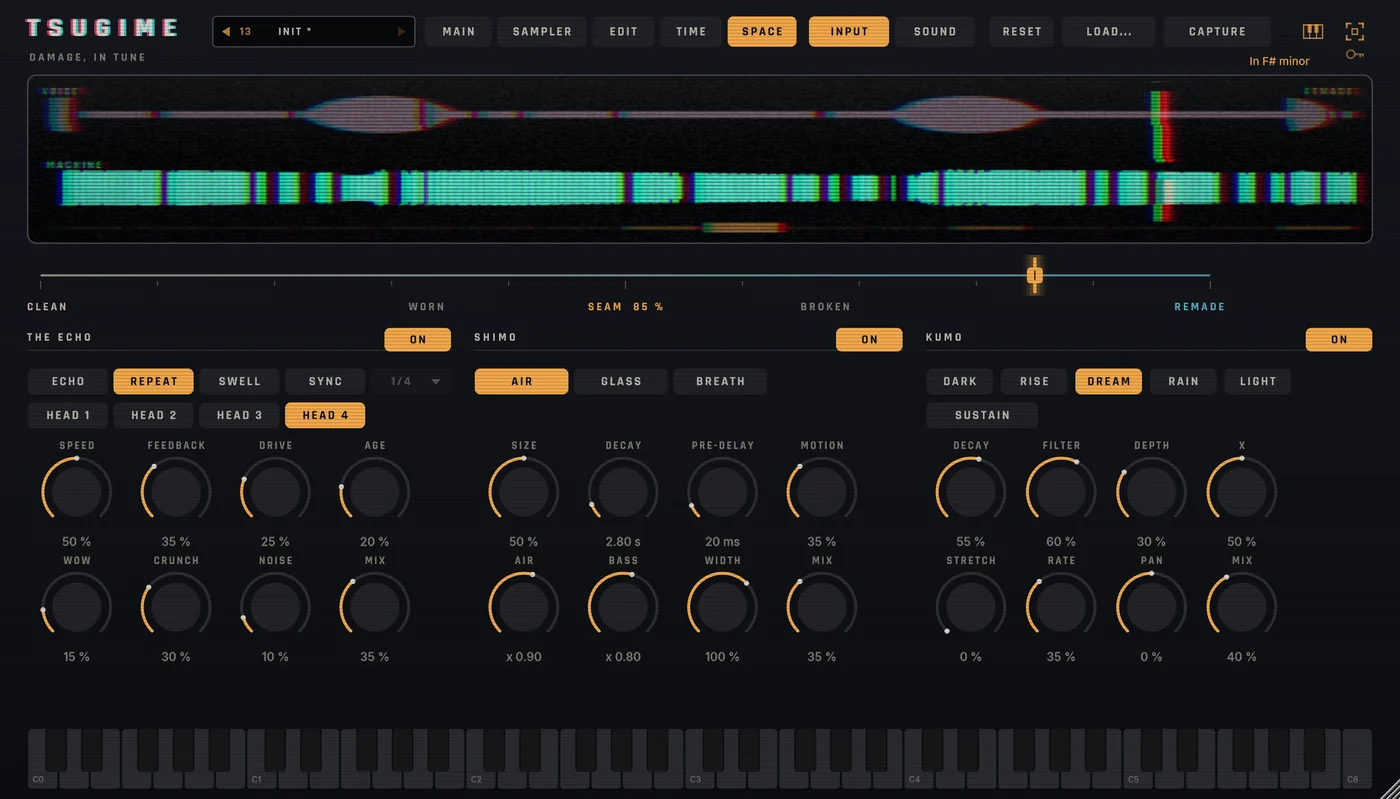
Technical
| Type | A destruction effect, in key and in time, with a sampler |
|---|---|
| The journey | One Seam: clean, worn, broken, remade, the level matched along it; Freeze; Age and Renew |
| Characters | Eight: Tape, Copier, Printer, Modem, Mains, Motor, Press, Chip, each with three colour knobs, its machine's settings and its remade voice's (saw, choir or chip) |
| In key | Key and scale (eight scales); In Key; the chord heard from the key, the notes held, or Kiri's through the generators' link; the Ring: twelve tuned strings (roots and fifths, the chord, the scale), Ring and Decay |
| Damage | Sixteen steps, 1/8 to 1/32 with swing: Repeat, Reverse, Stop, Crush, Drop, Pitch, Gate, each with a chance and an amount; eight patterns; Chance; on or between Kaminari's kick |
| Sampler | 36, 18 or 9 kHz, 16-bit, up to 10 s; trigger and length; start, end, loop with crossfade, reverse; 8 voices from the keys, or a drone; Crop and Undo, Save, Drag, Resample; Stretch and Fit |
| Tape | Cassette (Type 0, I, II, III, IV, wrong equalisation) or a VHS sound track; Depth, Wow, Rate, Dropout, Bias; the decay loop; breakdowns, free or on the beat |
| Effects | Kodama's drum echo, Shimo's and Kumo's reverbs |
| Factory programs | 12, plus Init (it opens on Init: clean) |
| Latency | 216 samples at 48 kHz (the machine's side and Kodama's echo), reported always |
| Output | Stereo |
| Panel | 1240 × 640 (708 with the keyboard), scalable from 60 to 160% |
| Format | VST3, and Audio Unit on the Mac · Windows 10 or 11, 64-bit, or macOS 12 or later (Apple silicon or Intel) |
| Manual | The owner's manual, as a PDF |
From the factory programs
Also in the studio
Kodama
木霊 · the echo that answers from the treesAn echo modelled on a spinning magnetic drum, with four playback heads, a drive stage in front and a spring reverb beside it.
Enter Airy ReverbShimo
霜 · frostA bright, clear reverb whose highs last as long as its middle, with a hall, a plate and a close halo that helps dry sounds breathe.
Enter Stereo Ambient ReverbKumo
雲 · cloudA stereo reverb for long ambient tails and slow blooms, with five algorithms that range from dark and heavy to bright and shimmering.
Enter