Kumo
雲cloud
Kumo is a stereo ambient reverb for long tails, slow blooms, and the sound that hangs in the air after the note has gone.
Character
A chord goes in. A cloud comes out.
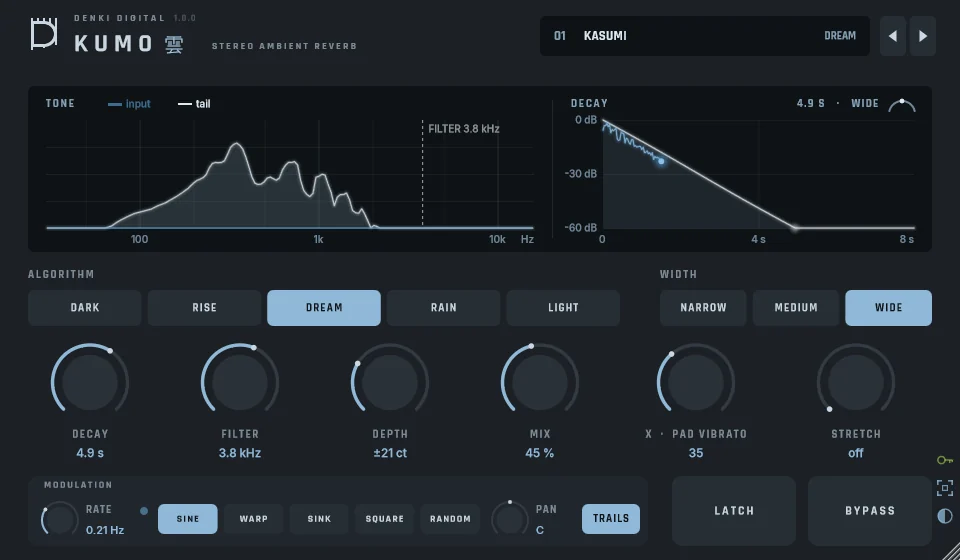
Some tails rise behind the note. Some fall like rain. One holds a pad in the air and lets it breathe, with a vibrato that sounds as if it was always there.
Turn Stretch and the whole space slows, darkens, and drifts.
Designer's notes
One of my favourite things to do is run my archtop guitar through a stereo reverb that specialises in ambient textures. The guitar was built in the 1930s, and it pairs well with the reverb, a modern classic of dreamy, stretched soundscapes. Kumo can do Dark, Rise, Dream, Rain and Light, each with its own distinct sonic character, and it sounds great whatever signal you feed it.
— Stephen Widden, Aberdeen
Listen
One take, played in Live: a loop that starts dry, Kumo's Mix brought up to half by hand, then back down to nothing.
Exported from Live, matched in loudness. Nothing added afterwards.
What it does
Five skies
Dream, Rise, Rain, Dark and Light. Each changes the character of the tank, and gives the X control a new purpose.
Dream
Press Sustain and Kumo listens, freezes what it heard, and keeps it alive under a slow pad vibrato.
Rise
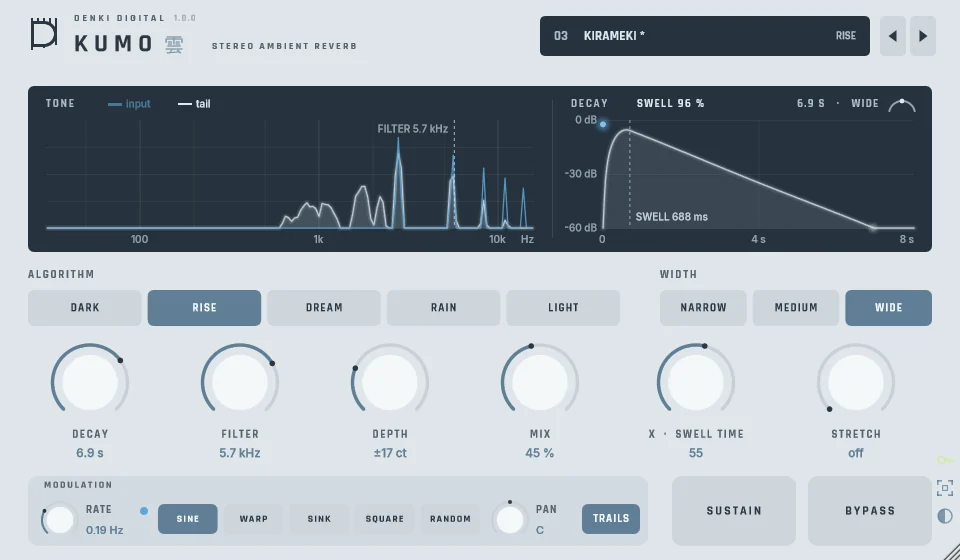
Tails that swell in behind the note, from a soft 80 milliseconds to four slow seconds.
Rain
Ten delay taps scattered through the tail, falling across the stereo field.
Dark and Light
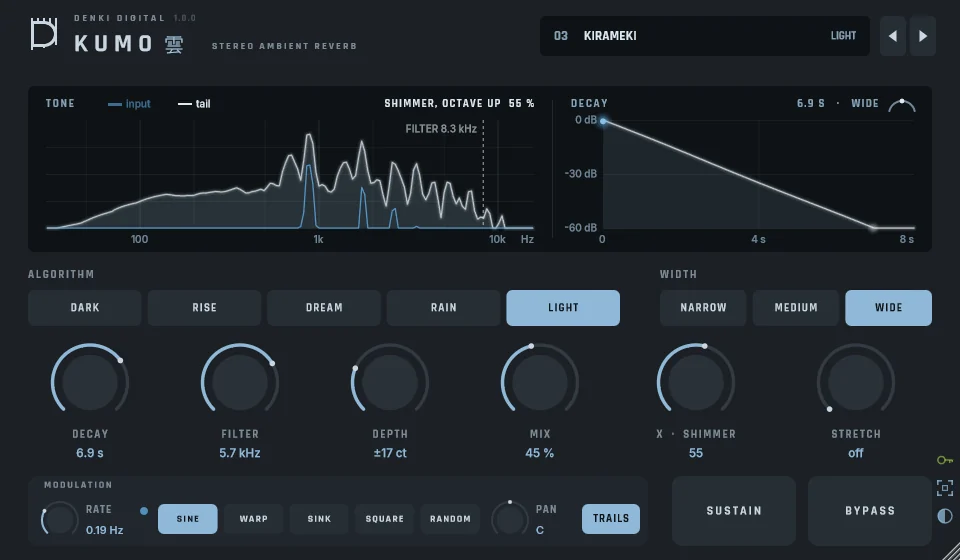
An octave below, for weight. An octave above, shimmering, for air.
Stretch
Slows the engine's own clock. Tails grow longer and darker; turn it while a tail rings and the pitch bends like a tired machine.
Movement
Five modulation shapes, Sine, Warp, Sink, Square and Random, from a slow drift to a seasick sway.
Width and trails
Narrow, Medium or Wide. With Trails on, the tail finishes its thought after bypass.
See the tail
A display shows the tail's tone against what goes in, with the filter and the octaves marked, and the shape of its decay drawn from your settings, with the real tail falling along it. In a dark finish, or a pale one at a click.
Views
Technical
| Type | Stereo ambient reverb |
|---|---|
| Algorithms | Dark, Rise, Dream, Rain, Light |
| Controls | Decay (0.35 to 25 s), Filter (700 Hz to 13 kHz), Depth, Mix, X, Stretch, Rate (0.05 to 6 Hz), Wave, Pan, Width, Sustain, Trails |
| Factory programs | 14 |
| Channels | Mono, mono to stereo, stereo |
| Format | VST3, and Audio Unit on the Mac · Windows 10 or 11, 64-bit, or macOS 12 or later (Apple silicon or Intel) |
| Manual | The owner's manual, as a PDF |
From the factory programs
Also in the studio
Shimo
霜 · frostA bright, clear reverb whose highs last as long as its middle, with a hall, a plate and a close halo that helps dry sounds breathe.
Enter Magnetic Drum EchoKodama
木霊 · the echo that answers from the treesAn echo modelled on a spinning magnetic drum, with four playback heads, a drive stage in front and a spring reverb beside it.
Enter Vintage Channel StripKohaku
琥珀 · amberA stereo channel strip based on the channel of an old rack mixer: a preamp that warms up as you push it, a two-band tone stage and a pair of VU meters.
Enter